Pfizer has released Phase 3 data for its mRNA flu vaccine, boasting 34% greater efficacy than the standard flu shot. On paper, this beats Moderna’s candidate, which demonstrated 26.6% efficacy.
If you trade on headlines alone, you buy Pfizer. If you trade on first principles, you recognise the trap.
The trials weren’t even testing the same thing.
The Demographic Divergence: Premium vs. Commodity
Pfizer’s 34.5% victory was achieved exclusively among adults aged 18–64. Moderna’s 26.6% victory, however, came from a massive trial of ~41,000 adults aged $50+, delivering a crucial 27.4% superiority in the 65+ demographic.
The 18–64 bracket is the commodity market. Very few people in this age group die or end up in the ICU from the flu.
The 65+ bracket is the premium market. That’s the group that actually fills hospital beds, racks up billion-dollar Medicare bills, and is the entire reason high-dose shots like Fluzone HD even exist.
Pfizer won the participation-trophy age group. Moderna won the one payer that will pay a premium.
The Influenza B Disaster
Then there’s the Influenza B disaster for Pfizer. This is the part that genuinely shocked me:
Pfizer’s shot was worse than the standard egg-based vaccine against Influenza B strains. Not just “slightly less good”—it missed. There is basically zero chance Pfizer gets this approved as-is.
Moderna faced this exact failure last year. They went back, re-engineered the shot, and the June 2025 data proves they fixed it: 29% greater efficacy against Influenza B.
Why Pfizer is Structurally Screwed
It comes down to structural engineering. The Hemagglutinin protein (the part of the virus the immune system targets) is notoriously unstable. If a company simply prints the basic mRNA instructions (which Pfizer likely did), the protein “flops” or misfolds. The immune system takes a picture of a collapsed building, resulting in weak antibodies.
Moderna didn’t just tweak the dose; they engineered “stabilizing mutations.” Think of it as adding steel scaffolding to the protein so it stands tall in a “pre-fusion” state long enough for the immune system to recognise the correct structure.
The IP Moat
This is the most critical factor: Moderna owns the patent on that scaffolding. US Patent No. 10,925,958 (“Influenza Vaccine”) specifically covers these RNA-encoded, stabilized Hemagglutinin structures.
Pfizer now has to either (a) license it, (b) fight the patent in court, or (c) invent some completely different stabilization method that doesn’t breach Moderna’s claims.
The Investment Thesis: A Strategic Moat
Pfizer’s delay will, at a minimum, miss the 2027 flu season. This ensures Moderna a critical first-mover advantage in the emerging respiratory super-cycle (COVID, Flu, and RSV).
This provides Moderna a clean runway to dominate the premium demographic with a fully validated formulation that works against all four strains, protected by IP that has already survived challenges.
While this development alone doesn’t constitute the ’10-bagger’ moment, it strategically secures Moderna’s position. It creates a robust, defensible business in an evolving market focused on combo COVID/Flu/RSV shots, capable of meeting demand during the next endemic or pandemic.
Crucially, the true value proposition is the robust, validated respiratory vaccine pipeline. This is a foundational step for future platform expansion into latent viruses, oncology, and a wide range of rare diseases. We are likely still very early in realising the full scope of this proprietary mRNA ecosystem.
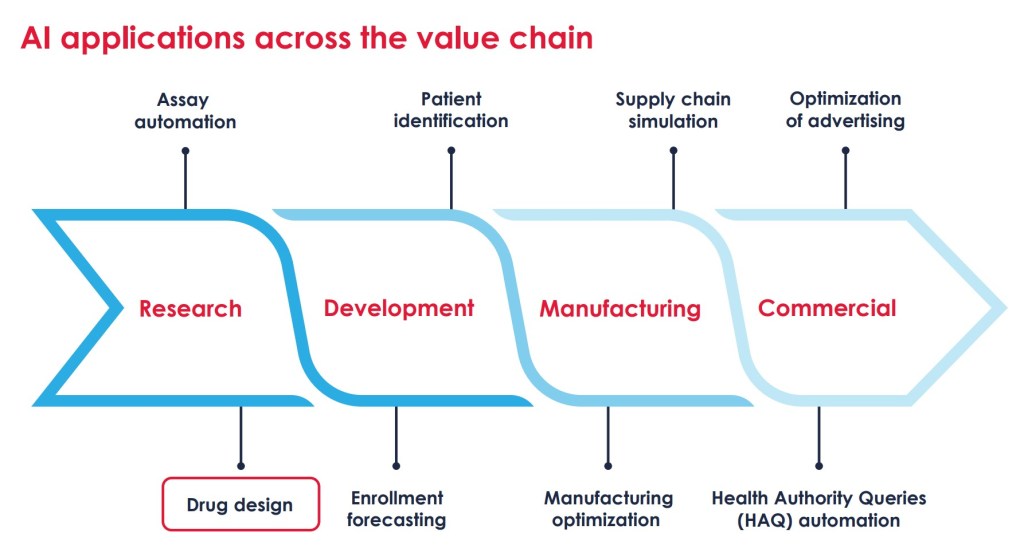
Moderna created the Spikevax vaccine, a miracle vaccine that saved millions of lives during the pandemic. Something not mentioned enough is how AI algorithms aided the vaccine in analyzing vast datasets to optimize the mRNA sequence in Spikevax.
While Spikevax isn’t an AI drug, it showed the potential of AI in accelerating and improving drug discovery. Moderna has always been an AI company since its founding in 2014. The impact of AI is seen almost everywhere in Moderna’s value chain, which makes it a leader in the space rather than a company responding to a hot secular trend.
mRNA vaccines have a bright future in medicine, and the story has just begun. mRNA is a molecule that teaches your cells how to produce antibodies that help fight certain diseases. The breakthrough discovery was utilizing Lipid Nanoparticles as a bubble to safely deliver the RNA (a fragile molecule) to its target cell. Once this happened, the technology was no longer theoretical but a signal that medicine had evolved.
The biggest challenge to Moderna and RNA technology is achieving efficient and targeted delivery to the suitable cells within the body. Optimizing RNA delivery efficiency to the desired cells remains a work in progress, but AI is streamlining this process with data analysis, experiment design, and manufacturing processes. These advancements have dramatically improved drug development efficiency, where we are no longer growing our drugs; we are printing them.
With Moderna experiencing tremendous advances in its platform, what does that mean for its future financial outlook?
Moderna estimates its combined annual revenue from its respiratory virus vaccines (COVID-19, RSV, and flu) to reach $8 billion to $15 billion by 2027.
Getting an approved RSV and flu vaccine would help Moderna return its revenue close to its peak during COVID-19, bringing in a whopping $19.3 billion in 2022.
Three approved respiratory virus vaccines may not propel its stock to all-time highs, but it would likely be significantly higher than where the stock trades today: In the 70-130 range.
What would be a paradigm shift for Moderna?
Moderna expects to add $10 billion to $15 billion in annual sales five years after launching new Oncology, Rare, and Latent diseases products by 2028. This is in addition to the previously announced $8 billion to $15 billion of expected sales from the Respiratory Franchise in 2027.
Moderna stock is undervalued and has a good chance of bouncing back. Whether it surpasses where it was in 2021 depends on how many approved vaccines it develops, the pricing, and the market adaption of each new product it launches.
My prediction. Moderna has 1-3 potential home runs in their pipeline outside of Covid. With a plan to launch 15 products in the next five years, one or two will likely be a blockbuster drug.
mRNA-4157 is a potential home run as a future cancer vaccine. Vaccines or therapeutic cancer treatments are always potential game changers because there is no effective cure for cancer. The timeline for a cancer vaccine is a long, unwinding road, but the results have shown promise against Melanoma, the key word being promise. Cancer therapeutics have always shown potential but are primarily unsuccessful. Although progress is very likely in the next five years, whether that will lead to a robust ROI is a complete mystery.
Moderna has many potential vaccines dealing with herpesviruses. There are over a hundred herpesviruses, but eight infect humans. Most people in the world have at least one of the eight herpesviruses:
Herpes simplex virus: double-stranded DNA virus
HSV-1 (oral Herpes): The most common type causes cold sores around the mouth. It can also cause genital Herpes, although this is less common.
HSV-2 (genital Herpes): This type of HSV causes genital Herpes, which can be painful and itchy. It can also be transmitted to a newborn during childbirth.
Human herpesvirus 3 (HHV-3): Varicella-zoster virus (VZV):
VZV is a viral infection that causes chickenpox in children and shingles in adults.
Human herpesvirus 4 (HHV-4): Epstein-Barr virus (EBV):
EBV is a widespread virus that infects most people at some point in their lives. It usually causes no symptoms, but it can sometimes cause Mono, a fever, and swollen glands.
Human herpesvirus 5 (HHV-5): Cytomegalovirus (CMV):
CMV is a common virus that can cause mild symptoms in healthy adults but can be severe for newborns and people with weakened immune systems.
Human herpesvirus 6 (HHV-6): Herpes 6
HHV-6 is a common virus that causes roseola, fever, and rash in young children.
Human herpesvirus 7 (HHV-7): Herpes 7
HHV-7 is a common virus that is often found in people with roseola, but it is not clear if it causes the disease
Human herpesvirus-8 (HHV-8): Kaposi’s sarcoma-associated herpesvirus (KSHV):
KSHV is a virus that can cause Kaposi’s sarcoma, a type of cancer, and multicentric Castleman disease, a rare inflammatory disorder.
There is a common theme with all Herpesviruses:
No cure.
Most people with herpes are asymptomatic: People can be infected with Herpes and not experience any symptoms. These cases often go undetected, contributing to the undercounting of total infections.
Very contagious and easy to spread in various ways.
The CDC does not recommend herpes testing for people without symptoms.
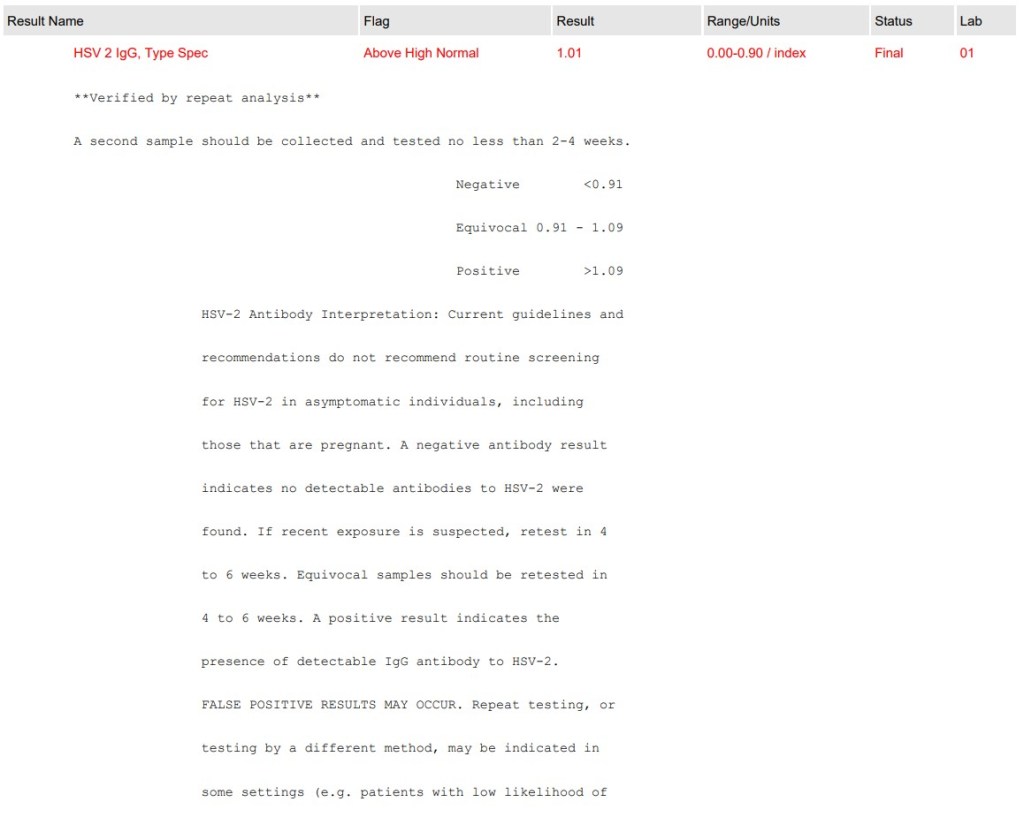
My test results indicate I have tested equivocal/positive for Herpes Type 2. Herpes Simplex Virus II is also commonly known as Genital Herpes.
Moderna has programs in development for Herpes simplex 1&2, VZV, EBV, and CMV.
Based on most conservative estimation models, 50% of the global population has oral Herpes, but more than 2 out of 3 people likely have it. Far more people, by a significant amount, have oral Herpes than are obese.
About 1 out of 8 people are more likely to have genital Herpes, but those estimates are likely conservative as well. The exact number is unknown, but it is expected more than 2 out of 10 people worldwide have genital Herpes. The complexity of the virus is that it is easy to spread even without symptoms, and it likely will not require any medical attention. Most people with Herpes do not know it, and the number of those who have recurrent painful outbreaks is in the minority.
Going through the process of getting tested for Herpes gave me insight into how profitable a vaccine would be.
My Western Blot results for Herpes Type 2, The Gold Standard for Herpes blood tests.
I recently took an STD Panel test and tested equivocal/positive for Herpes Type 2. I was pretty shocked as I never showed any symptoms. Mentally, it was starting to take a toll on my physique as I became worried every itch or pain was the beginning of an outbreak.
I learned that most standard blood tests for Herpes, when there are no sores or symptoms, are inaccurate. These tests are likely misinterpreting HSV-1 and HSV-2 antibodies with other antibodies your immune system produces.
I live in the only state in the United States that conducts the most accurate or “gold standard” for Herpes blood tests: The Western Blot at The University of Washington Virology Research Clinic. Through a referral from my provider, I was able to get my blood tested in person (anyone out-of-state has to mail their blood sample) and, after a week, received an official negative diagnosis for HSV-2.
Due to the complexity of the virus and the high number of asymptomatic cases or those that experience mild symptoms, a vaccine would create a massive opportunity with high demand and a large market.
Anyone who suffers from frequent outbreaks of Herpes is likely interested in a potential vaccine. More people would probably get tested if a safe vaccine were available, revealing a more prevalent virus than current studies suggest.
Even though Herpes doesn’t seem like a big deal, the stigma and psychology of the virus are real, particularly genital Herpes. How much money would you pay for a vaccine that would likely make having sex more accessible and safer?
Cancer and Herpes are only two potential growth catalysts for Moderna. The company has a long runway for growth, with over 45 developing drugs and 38 ongoing clinical trials. There’s a buffet selection of diseases, even though most of these trials will fail. Getting 10-15 drugs approved in the next five years could give Moderna a higher market cap than any other biotech company.
mRNA technology is still in its infancy. There are hurdles and uncertainty ahead, but the future looks exponentially promising. With many potential applications, this has the feel of the Internet or mobile phone in the early 1990s. Ten years from now, we will not look at mRNA as a fad but as a widely used technology much more significant than we could conceive today.
What’s wildly exciting is that we likely don’t know many things. Investing in what you don’t know is typically seen as a negative, as you can have blind spots toward risk factors. It’s important not to downplay the potential for a blue-sky scenario. The more we understand RNA and how to improve its delivery, the more likely we can see its capabilities and applications increase. Our current expectations may not be high enough. Moderna is developing drugs that can change the world and revolutionize medicine. It is important to remember the miraculous progress made in the past five years.


 Invest in Myself