Revolve’s Superpowers: A Rare and Powerful Combination Most Investors Completely Overlook

Revolve Group (NYSE: RVLV) is the forgotten champion of apparel retail. While Wall Street obsesses over hyper-growth names and retail investors chase the next meme stock, Revolve quietly operates one of the strongest, most defensible business models in the entire consumer sector. It’s dismissed as “just another overpriced clothing seller,” but that superficial take misses two genuine superpowers that are extraordinarily rare in the apparel sector. This unique combination creates a company that is antifragile in a brutal, cyclical, low-margin industry, a combination that deserves far more attention than it gets.

Superpower #1: A Pristine, Fortress-Like Balance Sheet

Revolve has more cash and cash equivalents than total liabilities. This isn’t total assets minus liabilities. This is cash-on-hand exceeding all debt. As of September 30, 2025, Revolve held $315 million in cash, with total liabilities of just $226, leaving it net cash positive by nearly $90 million. (Revolve Group Announces Third Quarter 2025 Financial Results, 2025) In an industry notorious for leverage-fueled boom-and-bust cycles, this is almost unheard of. Look at Revolve’s closest competitors and legacy apparel names:

  • The RealReal → Negative net cash, drowning in $500+ million of debt
  • Victoria’s Secret → $4 billion in long-term debt, with cash covering only a fraction.
  • Guess? → Leveraged with debt-to-equity over 2x
  • Macy’s, Kohl’s, Abercrombie in their prior incarnations → Perpetual debt refinancings amid endless store closures

Most apparel retailers use leverage as oxygen. Revolve doesn’t need it. Zero net debt (actually net cash) gives them a massive margin of safety that investors in this sector are simply not accustomed to. In a downturn, Revolve can keep the lights on indefinitely without ever visiting a bank. In an upturn, they can aggressively buy back stock (they’ve already repurchased over 20% of shares outstanding since their 2019 IPO, including $100 million authorized in 2023), or acquire distressed brands/competitors for pennies on the dollar. Having such a fortress balance sheet creates real optionality.

Superpower #2: Consistently Elite Gross Margins (54% and Climbing)

The average apparel retailer scrapes by with gross margins of 30-50%. Revolve delivered a 54.6% gross margin in Q3 2025 (up 350 basis points YoY) and has maintained a 50-55% gross margin range for years. For context:

  • Louis Vuitton (LVMH) → 66%
  • Lululemon → 59%
  • Zara → 55-57%
  • Most everyone else → 30-45%

Revolve is operating at the same rarefied level as the very best branded apparel players on earth, despite being a pure-play online retailer without a physical-store crutch. Why does this matter so much? Because elite margins are Revolve’s ultimate defense against Amazon. Retail investors see “expensive clothes” and assume the model is fragile. In reality, those premium prices are the moat. Millennials and Gen Z raised on Instagram and TikTok aren’t shopping for the cheapest white t-shirt: they’re buying an identity, or an outfit that photographs well at Coachella. Revolve sells social currency. Customers happily pay 2–3 times more for the outfit that might cost less elsewhere because they’re paying for curation, discovery, and status. That willingness to pay a premium is exactly what produces 54%+ gross margins and sustains an average order value of $306 in Q3 2025 (up 1% YoY).

And those margins are what keep Amazon at bay. Amazon dominates commodity fashion: fast, cheap, endless selection. If Revolve ever tried to compete on price, Amazon would crush them with its scale and logistics. But Revolve isn’t playing that game. They’re playing the art of the brand premium game, something Amazon isn’t going to win. Even after 25+ years and billions invested, Amazon has failed to crack premium or luxury fashion in any meaningful way, with a fashion gross margin hovering around 20-30%, far below the industry standard. Jeff Bezos himself has admitted that building a real fashion brand is one of the few things Amazon hasn’t figured out.

The Rare Combination

Put the two superpowers together, and you get something compelling:

  • A net-cash balance sheet → survives any storm, buys back stock aggressively, and is opportunistic with M&A.
  • 54%+ gross margins → funds growth, defends against Amazon, produces torrents of free cash flow (up $265% YoY to $59 million in the first nine months of 2025.
    • This defensive balance sheet and offensive margin profile is the definition of antifragile in retail.

Revolve is clearly doing something different: one that builds on digital and social infrastructure to erect a curation and brand moat. They sell the Revolve experience, which allows them to charge premium, full-price prices (high Average Order Value). Using first principles, Revolve’s main product isn’t a dress; it’s the marketing expense. The influencer trip is not just a cost; it is the intangible asset that allows them to maintain a $300 price point for a dress. This experiential luxury marketing, powered by a network of 5,000+ influencers, has driven its owned-brand penetration to 35% of sales, further boosting margins.

The focus on experiential luxury marketing allows Revolve to build a digital model while using temporary pop-ups as low-CapEx market research before committing to a permanent location. Their Aspen pop-up in December 2024 converted to a full flagship in June 2025 after crushing performance metrics, and they’re replicating the playbook with a permanent store at LA’s The Grove. Focusing on brand experience, margins, and building a cash fortress creates optionality, which is a much different playbook than most apparel retailers play: heavy CapEx expansion to drive growth, which is more inflexible and likely requires leverage.

Very few companies in any industry possess both traits simultaneously. When you find one, especially one trading at a reasonable earnings multiple with a proven ability to grow, it’s worth paying attention. Revolve isn’t a “hot” stock. It doesn’t have 150% YoY growth. It is a quiet, compounding machine built on genuine structural advantages, like a pristine balance sheet and 54% margins that the market keeps overlooking.

The Headline Trap: Why Moderna Wins with the Lower Number

Pfizer has released Phase 3 data for its mRNA flu vaccine, boasting 34% greater efficacy than the standard flu shot. On paper, this beats Moderna’s candidate, which demonstrated 26.6% efficacy.

If you trade on headlines alone, you buy Pfizer. If you trade on first principles, you recognise the trap.

The trials weren’t even testing the same thing.

The Demographic Divergence: Premium vs. Commodity

Pfizer’s 34.5% victory was achieved exclusively among adults aged 18–64. Moderna’s 26.6% victory, however, came from a massive trial of ~41,000 adults aged $50+, delivering a crucial 27.4% superiority in the 65+ demographic.

The 18–64 bracket is the commodity market. Very few people in this age group die or end up in the ICU from the flu.

The 65+ bracket is the premium market. That’s the group that actually fills hospital beds, racks up billion-dollar Medicare bills, and is the entire reason high-dose shots like Fluzone HD even exist.

Pfizer won the participation-trophy age group. Moderna won the one payer that will pay a premium.

The Influenza B Disaster

Then there’s the Influenza B disaster for Pfizer. This is the part that genuinely shocked me:

Pfizer’s shot was worse than the standard egg-based vaccine against Influenza B strains. Not just “slightly less good”—it missed. There is basically zero chance Pfizer gets this approved as-is.

Moderna faced this exact failure last year. They went back, re-engineered the shot, and the June 2025 data proves they fixed it: 29% greater efficacy against Influenza B.

Why Pfizer is Structurally Screwed

It comes down to structural engineering. The Hemagglutinin protein (the part of the virus the immune system targets) is notoriously unstable. If a company simply prints the basic mRNA instructions (which Pfizer likely did), the protein “flops” or misfolds. The immune system takes a picture of a collapsed building, resulting in weak antibodies.

Moderna didn’t just tweak the dose; they engineered “stabilizing mutations.” Think of it as adding steel scaffolding to the protein so it stands tall in a “pre-fusion” state long enough for the immune system to recognise the correct structure.

The IP Moat

This is the most critical factor: Moderna owns the patent on that scaffolding. US Patent No. 10,925,958 (“Influenza Vaccine”) specifically covers these RNA-encoded, stabilized Hemagglutinin structures.

Pfizer now has to either (a) license it, (b) fight the patent in court, or (c) invent some completely different stabilization method that doesn’t breach Moderna’s claims.

The Investment Thesis: A Strategic Moat

Pfizer’s delay will, at a minimum, miss the 2027 flu season. This ensures Moderna a critical first-mover advantage in the emerging respiratory super-cycle (COVID, Flu, and RSV).

This provides Moderna a clean runway to dominate the premium demographic with a fully validated formulation that works against all four strains, protected by IP that has already survived challenges.

While this development alone doesn’t constitute the ’10-bagger’ moment, it strategically secures Moderna’s position. It creates a robust, defensible business in an evolving market focused on combo COVID/Flu/RSV shots, capable of meeting demand during the next endemic or pandemic.

Crucially, the true value proposition is the robust, validated respiratory vaccine pipeline. This is a foundational step for future platform expansion into latent viruses, oncology, and a wide range of rare diseases. We are likely still very early in realising the full scope of this proprietary mRNA ecosystem.

UnitedHealth: Navigating the Fog of War in Healthcare

Investing in the U.S. healthcare sector is akin to navigating a battlefield shrouded in fog. Stocks like UnitedHealth (UNH), Oscar Health, Progyny, Hims & Hers Health, or even Novo Nordisk may seem appealing, but a minefield of uncertainties surrounds them. I am skeptical whether UNH is the obvious value play.

Picture this: Deploying your capital is like sending troops into hostile, unpredictable terrain. If you’ve ever tangled with the American healthcare system, you know it’s a chaotic web of shifting regulations, bureaucratic red tape, and outright irrationality that can derail even the savviest investor’s plans.

UNH: A Distraction in the Fog

UnitedHealth is currently under a microscope, with the Department of Justice launching both civil and criminal investigations into potential fraud in its Medicare billing practices. These investigations, which are focused on allegations of overcharging and improper billing, could have significant financial and reputational implications for the company. For a long-term investor, this is a massive distraction. Regulatory scrutiny doesn’t just threaten your investment—it demands your time and energy, which are better spent hunting for truly innovative opportunities.

Is the broader healthcare sector undervalued? Signs suggest yes. But “undervalued” alone doesn’t justify making UNH a core holding. Short-term catalysts for a rebound are scarce. Unlike tech companies that can pivot swiftly, UNH is mired in a labyrinth of state and federal oversight, slowing progress to a crawl. This screams low-risk, low-reward: Park your money here, and you might watch it stagnate as inflation erodes your purchasing power.

The Opportunity Cost Trap

The real danger isn’t just losses—it’s opportunity cost, the silent killer that drains your portfolio’s potential. Opportunity cost is the potential benefit that is foregone when one alternative is chosen over another. Consider investors who snapped up ‘bargain’ Boeing shares during the pandemic. Sure, Boeing was cheap, with bankruptcy risks cushioned by its ‘too big to fail’ status and a near-duopoly in aviation. A Boeing bull might argue: ‘I’m up 30-50% over five years—what’s the problem?’ Two issues stand out:

  1. That 30-50% lags the S&P 500’s 90-100% surge over the same period. Why take single-stock risk for returns that trail a broad index with far less stress?
  2. Tying up capital in Boeing meant missing rockets like Nvidia’s jaw-dropping 1,500%+ run or the stellar gains from Palantir and MicroStrategy.

Piling into UnitedHealth feels like queuing for hours at a hyped-up New York City pizza joint for a $60 pie. Sure, it’s tasty, but was it worth skipping faster, cheaper (and equally delicious) options that don’t hijack your entire day?

I understand the appeal of this sector, having invested in healthcare stocks myself. But is now the right time to go all-in on UNH? I recommend a more cautious approach. In a market where value is hard to find, it’s important not to rush into a potential minefield just because it seems cheap. Patience and a keen awareness of opportunity cost can be your most powerful tools. Instead of making a significant investment in UNH, consider waiting for clearer signals where valuations don’t come with a heavy burden.

Is Lemonade (LMND) Becoming Dangerously Good?

Philadelphia Phillies starting pitcher Zack Wheeler

As an investor, I’ve had a love-hate relationship with Lemonade stock. I loaded up too heavily right after its 2020 IPO, only to regret not buying more aggressively when shares dipped into single digits. If you’re considering this name, approach it with caution—it’s a classic high-risk, high-reward bet. Lemonade remains a young company in its growth phase, far from maturity.

In hindsight, the stock’s wild ride in 2021 was fueled by meme-stock mania. It skyrocketed to $188.30 on January 12, 2021, despite the company having under one million policyholders and no auto insurance offering at the time. That bubble burst spectacularly, but beneath the surface, Lemonade’s fundamentals are showing real signs of improvement.

Back to the Drawing board:

The company has always excelled in technology, innovation, and customer acquisition. Profitability, however, has been its Achilles’ heel. I’d liken Lemonade to a highly touted high school baseball pitcher: a laser fastball and a nasty arsenal of pitches, but zero command on the mound. Without control, even the most talented arm flames out quickly; a great repertoire of pitches means nothing if you don’t know where the ball is going.

For a while, its business model reflected this wildness: impressive growth and customer attraction (the 103-mph fastball and filthy slider) were negated by sloppy underwriting (walks and hit-by-pitches). Critics often hammered the company’s high loss ratio as an unsustainable business model.

Think of Lemonade as a young Roy Halladay or Zack Greinke. Both were first-round draft picks who bombed early in their MLB careers, getting demoted to the minors amid mechanical issues and poor results. But they adapted, refined their approach, and emerged as Hall of Famers. Lemonade is on a similar trajectory.

Rebuilding the mechanics

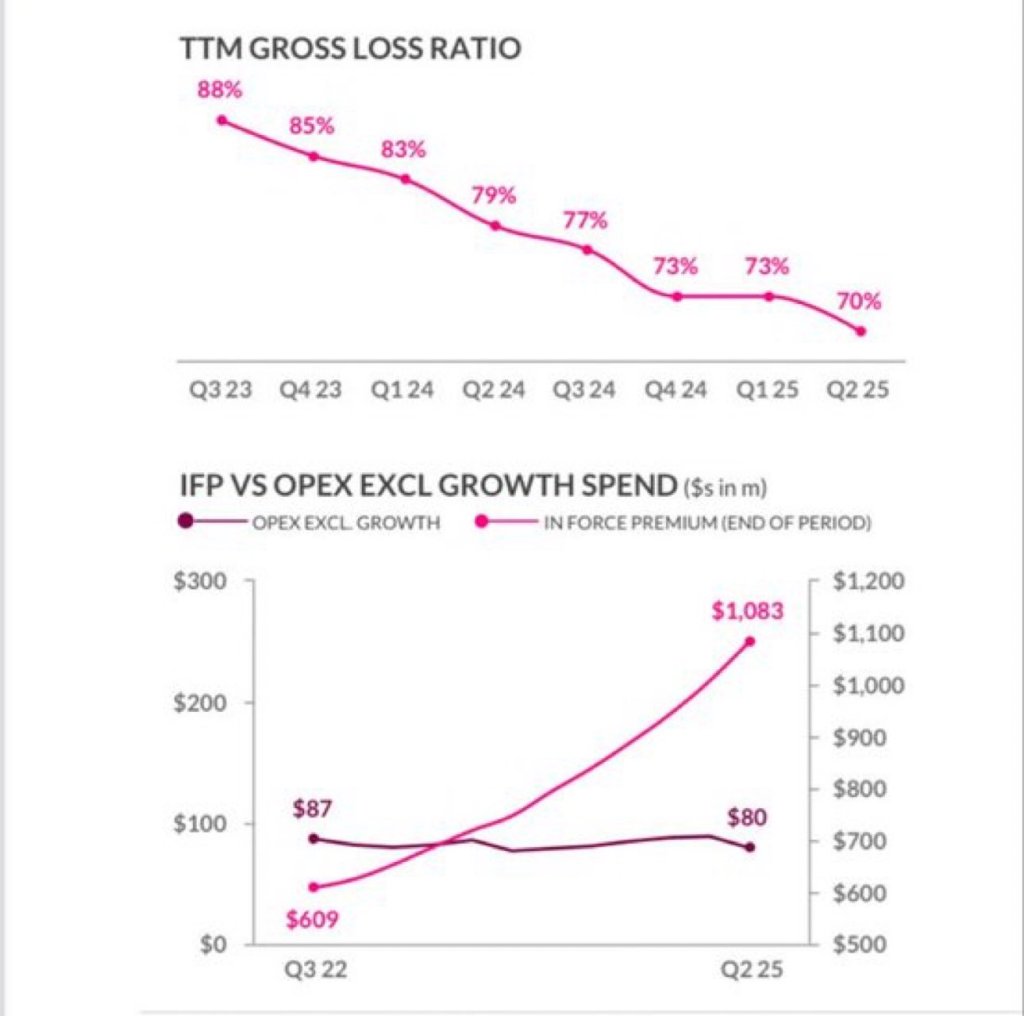
The data over the most recent quarters tells a story of Lemonade tackling its core risks head-on:

  • Loss ratios are improving dramatically, signaling better risk management and a tighter command of its underwriting.
  • It has slashed its quota-share reinsurance from ~55% to ~20%, meaning it now keeps more of the premium (and risk) in-house.
  • After pulling back on its auto insurance rollout, underwriting discipline has strengthened, setting the stage for renewed expansion.

At its core, Lemonade’s business isn’t as complicated as it seems. It’s exceptional at drawing in new customers through its AI-driven, user-friendly platform. If it can continue tightening risk controls, revenue growth should accelerate while losses/expenses stabilize.

The Bull Case Ahead

Wall Street is sleeping on the roadmap ahead. I expect Lemonade to rev up its auto insurance product, expanding beyond the current nine states. New offerings like phone or travel insurance could further juice growth, pulling more users into the ecosystem and unlocking bundling discounts for multi-policy holders.

I’m not hyping this as a sure thing, but my optimism feels more grounded now: rooted in a business that appears primed for scalable profitability. That said, risks abound: Lemonade lacks a deep moat against competitors or economic headwinds, and plenty could still derail it, much like a pitcher blowing out their elbow on a single throw.

Analysts will likely pile in late, chasing momentum rather than leading the charge. I could be wrong, falling into the retail investor trap of being too early or clinging to a thesis that fizzles. Uncertainties remain, but Lemonade looks increasingly deserving of a small portfolio allocation. The bull case could spark explosive upside volatility, especially as AI evolves from infrastructure plays (like Nvidia or Google) to application-layer disruptors. Lemonade’s AI-powered insurance model positions it to capitalize on this shift, potentially delivering venture-like returns in the years ahead. While it’s no Palantir clone, the ride ahead could be like an epic roller coaster.

Tapestry (TPR): Deep Value to Cautious Optimism

In 2016, I invested in Tapestry (TPR), betting on Coach as an undervalued brand poised for a turnaround. It was one of the first stocks I bought as a new investor. My thesis was straightforward: the stock could reclaim its March 2012 peak of $79.70. Nearly a decade later, my prediction proved correct, though the road was far from smooth.

Tapestry faced significant challenges, including the 2019 ousting of its CEO, the 2020 resignation of another due to ‘personal misconduct,’ and a 2024 court ruling blocking its merger with Capri Holdings. Yet, TPR has outperformed the likes of LVMH, Lululemon (LULU), Capri Holdings (CPRI), and Nike (NKE) over the past five years—the very stocks I eyed when TPR struggled. Those same peers now sit well below their prior peaks.

I acknowledge luck played a role. Had the Capri merger proceeded, TPR would likely be trading in the $50–$70 range today, far below its current levels. Now, with TPR soaring past its 2012 high, I’ve shifted my strategy and trimmed my position to lock in long-term gains. If the stock continues to climb, I’ll likely reduce my holdings further.

My original thesis—that Coach was trading at a bargain—no longer holds. In a tough luxury market, Coach has unexpectedly gained pricing power for a mid-tier brand, fueled by a reshaped brand narrative and the TikTok-driven success of its Tabby Bag. However, Kate Spade, accounting for about 15% of revenue, remains a weak link due to inconsistent branding and declining sales, tempering my optimism.

Management deserves credit for Coach’s turnaround, but I remain cautious. Tapestry’s cyclical nature ties its success directly to consumer spending and economic conditions. A weakening economy would likely pressure sales.

Tapestry’s acquisition strategy is my primary concern. Selling the unprofitable Stuart Weitzman brand was a smart move, but the pursuit of the Capri merger suggests management may doubt Coach’s standalone growth potential. Given the lackluster outcomes of the Stuart Weitzman and Kate Spade acquisitions, future M&A activity could increase debt and strain cash flow.

My suggestion? If Tapestry is set on acquisitions, it should issue new shares to fund a targeted purchase, such as a niche luxury brand with strong growth potential. This approach would preserve cash and avoid debt, though it risks diluting existing shareholders. It could create more long-term value than increasing the dividend or buying back stock to where it’s trading currently—an action that offers limited upside if the stock corrects.

While I’ve enjoyed reinvesting dividends during the stock’s recent climb, weaker economic indicators, like declining retail sales, suggest uncertainty ahead. Most companies in the consumer cyclical sector face headwinds from slowing spending, and TPR is no exception.

That said, TPR isn’t wildly overvalued. With an upcoming earnings report and Investor Day looming in September, short-term upside potential remains. I’m cautiously optimistic and will monitor these events. My goal is to sell more shares at a higher price before the end of the year.

Why Palantir Reminds Me of Gangnam Style

Palantir redefined data analytics, while Gangnam Style redefined K-pop. Both achieved unexpected success through unconventional approaches, capitalizing on the right timing, transformative momentum, and cultural context.

Palantir, whose stock has surged over 400% in the past year, has become a focal point in the AI movement, despite its 20-year history. Similarly, Psy was already a veteran artist in South Korea, having started his career in 1999, 13 years before the global phenomenon’ Gangnam Style’ was released in 2012. The video eventually became the first on YouTube to reach one billion views.

Both share the same superpower: unorthodoxy, which helps them stand out in a competitive field. Palantir has unexpectedly fueled the spirit of AI-driven operations, just as Gangnam Style helped usher in K-pop on a global level. Alex Karp, an unconventional CEO, and Psy, the highly unconventional K-pop artist, embody this spirit of unorthodoxy.

Grappling with Valuation:

As a Palantir shareholder, am I saying this is the “peak” for the company? I don’t know. It seemed things were getting frothy when Palantir surpassed Lockheed Martin’s market cap; now it has a larger market cap than Lockheed Martin, Boeing, and Snowflake combined.

From a price-to-earnings or even price-to-sales ratio perspective, Palantir makes zero sense. While a projected growth rate of 36% is impressive, it falls short of what Zoom Communications achieved during the pandemic or what Nvidia has accomplished over the past three years.

It’s very possible that Palantir’s growth may have already peaked or is nearing its peak. I have little doubt, though, that the company has a long and successful future. However, I am highly uncertain if Palantir can grow enough to meet its sky-high valuation. Any signs of slowing growth could lead to a steep retracement. Any broader market correction or shift in sentiment could lead to a significant decline.

Even though I’m tempted to trim and sell more (if not all) of my shares every time the stock rises, it’s difficult to fight against momentum. Palantir is a profitable free cash flow machine, and its commercial business is in an early growth phase. The story remains compelling. There is little wrong with the actual fundamentals of the company; the focus of late has been predominantly on valuation metrics.

Lessons from Psy:

What Gangnam Style can teach us about Palantir is that a valuation doesn’t have to make sense to justify itself to keep rising. Momentum and narrative transcend numbers (even though Palantir’s numbers are solid).

As T-Pain said, words cannot describe how amazing the music video for Gangnam Style is. The video itself doesn’t make much sense, yet it has dominated globally:

This is an almost Dada-esque series of vignettes that make no sense at all to most Western eyes. Psy spits in the air while a child breakdances, sings to horses, strolls through a hurricane that shoots whipped cream in his face, there’s explosions, a disco bus, he rides a merry-go-round, dances on boats, beaches, in car parks and in elevators and generally makes you wonder if you have accidentally taken someone else’s medication.

Hit video may have a subversive message

I believe the numbers cannot fully capture the actual value of Palantir as a business. My brain struggles to grasp its market cap, and a voice within me says, “This is as good as it will get.” My heart tells me this growth story has a lot more breadth. It has the potential for a longer runway compared to unprofitable companies like Snowflake, CrowdStrike, and Cloudflare.

Perhaps this narrative about Palantir being grossly overvalued could be right and wrong at the same time. In the short term, Palantir is due for an inevitable and painful correction, but proves itself not as a ‘hype meme growth AI stock’ but more akin to a ServiceNow or Microsoft, where they are early in their business lifecycle and maintain a robust growth rate for an extended period.

Palantir’s story shows that powerful momentum can outpace solid fundamentals for a long time. Like Psy’s viral hit, its valuation may defy logic, but that doesn’t mean you sell the whole position. Stay disciplined: believe in the vision, but prepare for volatility.

Through the Casino and Back to Wealth-Building Wisdom

“The only way to win in a casino is to own one… unless you’re very lucky.”

— Steve Wynn, in a candid chat with Charlie Rose

“Even when people are lucky, they usually gamble away their winnings.”

— Charlie Rose, pressing the point

“You know nobody who, over time, comes out ahead?”

“Nope.”

— Steve Wynn, unapologetically blunt

Charlie Rose Interviewing Steve Wynn – Transcript

Over the past two years, I have spent a lot of my free time gambling at the casino. I would experience the full buffett of offerings – blackjack tables, baccarat bets, craps rolls, roulette spins, sports wagers, and slot machines. The time spent on gambling has distracted me from more important activities like investment research. Overall, the experience was a slow bleed (surprise) on my wallet and created more negative expected value than any entertainment benefit I may have received. The silver lining is that I could reflect on this experience and re-examine my behavior with a more sharpened perspective, returning to my disciplined and patient approach to investing.

The Dopamine Trap: Chasing the High

I started gambling just to try it out. I was bored one night and willing to try something new. I had gambled once on a slot machine in my 20s. From starting this “hobby,” I could feel the anticipation build up, even driving to the casino. I knew from the start there was an issue because I sometimes would become irritated being stuck in traffic. I couldn’t get there fast enough. That’s the dopamine kicking in, which had always been highest before I gambled.

The reason I enjoy gambling is the exact reason I hate it: the allure of unpredictable outcomes, which causes a jerk in your emotions like a yo-yo.

  • I made my first sports bet on the Falcons vs. the Commanders and watched the game like a kid, living on every play. The game concluded in overtime, and I lost $700.
  • Betting over $100 on a single hand of blackjack.
  • Making over $1,000 in less than 15 minutues of craps.
  • Losing over $500 on a single roll of the dice in craps.
  • Losing over $1,000 in 7 minutes on a slot machine.
  • Winning it all back and more on a single $3 slot machine bet.

Even for a level-headed guy, this rollercoaster was dizzying. I chased losses for hours, blew past my budget, and felt the sting of regret more often than the thrill of victory.

The Mirage of “Getting Rich”

All gamblers want to make money. Unfortunately, gambling in the long run will likely lead you to lose money. A non-gambler (net return of zero) will beat 95% of the returns of all gamblers.

The reason most gamblers lose can be summed up very simply: The odds of losing money are much higher than the odds of making money. Even though slight, the mathematical advantage (house edge or vig) is likely insurmountable in the long run. Imagine the Los Angeles Lakers having to play all their games on the road, or the New York Yankees only allowed to carry a 24-man roster.

From a pure risk-reward perspective, every bet either carries too much risk that does not justify the reward like high coverage roulette strategies or the iron cross method in craps. Or the handful of wins does not overcompensate for the avalanche of losses you get from picking a few numbers on roulette or continuously grinding on a slot machine.

When I accepted that I was unable to beat the casino, gambling became much less appealing. Even with short-term variance and playing “smarter,” I finally admitted to myself that gambling is an inefficient way to make extra income and an even more unrealistic way to build wealth.

That’s why I chuckled when I heard a fellow gambler say, “I need to make smarter bets.” The reality is that “gambling smartly” or “responsible gambling” is an oxymoron. No matter how “smart” you play, the casino is built to outlast you.

When gamblers say this, they typically mean either making smaller bets or not going “full tilt.”

Whether you are betting in smaller increments or just a few large bets, the odds remain stacked against you. Betting with a smaller budget just means you are losing money less quickly. In the long run, the results will likely produce a negative return.

Naivety and Immaturity:

Some of you may be wondering how I can be so ignorant as to think I could prosper from gambling. I have made the “smart” decision to invest in Nvidia and Palantir early and continue to hold long-term. How could I be so gullible?

  • The casino often offers free food, play, gifts, and comped rooms to give the impression that you are winning. Many five-star resorts, like the Wynn or Venetian, provide a flawless, impeccable, best-in-class guest experience.
  • Winning several jackpots (over $1,200 on a single win) on slot machines has distorted my analytical thinking, providing a false sense of confidence in games where you have zero control based on random events.
  • I vastly underestimated how the casino environment clouded my discipline and made me more comfortable taking unnecessary risks.
  • Going to the casino was not purely motivated by financial gain but by the dopamine hits and escapism.

It wasn’t just about money. I was chasing dopamine hits and an escape from reality. Tying my checking account to sparkly animations or a dice roll feels absurd. My Las Vegas coin-in/coin-out statement? Humiliating. My local casino doesn’t even provide a detailed win/loss record, which only adds to the haze.

Reflection and Moving Forward

I am a super competitive person. Playing games where the advantage is not in my favor seems unwise. It is even sillier to build wealth based on sparkly animations on a screen or a random roll of the dice.

Since diving into gambling, I’ve lost about $5,000. To some, that’s pocket change; to pro gamblers, it’s amateur hour. My investment portfolio sees bigger swings daily. But here’s the potential impact: if I’d put that $5,000 in the S&P 500 five years ago, it’d be worth over $10,000 today. In Nvidia? Try $85,000. Instead, I’m down $5,000, with nothing but fleeting thrills and a gambling hangover to show for it—those mornings after a big loss when I’d rather call in sick from work than face the day.

Do I have a gambling problem?

My Problem Gambling Severity Index score of 6 flags me as moderate risk—not an addict, but not out of the woods. I’ve never touched debt or my investments to fund bets, and I trust my mental resilience to keep me grounded. Will I quit for good? Honestly, I’m not sure. Gambling has some entertainment value, but often feels like a second job. I’m too competitive to play without obsessing about how much I am up or down.

Investing vs Gambling: Two Different Games

Since gambling is a game of chance, you will often get variable outcomes. I have chased losses (not advisable) and won jackpots. I have doubled down on hands, risking my entire bankroll, and beat the dealer.

Could a hyper-disciplined “Rain Man” gambler break even or profit? Sure, it’s possible. But probable? No. And even if you’re that rare winner, is it worth the grind? There’s a smoother path: open your brokerage account, buy an index fund or a solid stock, and let time do the heavy lifting.

The casino’s relationship with you is a one-way street—it wants your money, not your success. No amount of complimentary cocktails or VIP perks changes that. For the broke, it’s a poverty trap. For the rich, it’s a slow drain. For everyone, it’s a time suck. Investing, though? It’s the greatest show on earth. Analysis and patience build wealth with the odds in your favor. It’s not as sexy as a jackpot but rooted in real economic value, not chance.

Be the Casino, Not the Gambler

“Well, it requires patience — which a lot of people don’t have. People would much rather be promised that they’re going to win [on] a lottery ticket next week than that they’re going to get rich slowly. Gus Levy used to say that he was long-term greedy, not short-term greedy. If you’re short-term greedy, you probably won’t get a very good long-term result.”

— Warren Buffett, preaching the gospel of patience

Early in life, I learned that investing is the true superpower in building wealth. For long-term investors, you have the house edge.

There are three main advantages investing has over gambling:

  • Control over risk: You choose your investments and manage exposure.  
  • Purpose: You’re building wealth, not chasing chance.
  • Positive expected returns: Over time, markets trend up.  

No poker pro has built a billion-dollar fortune from cards alone. Nevada’s richest? Miriam Adelson is worth $28 billion thanks to owning casinos. Want to win like the house? Invest in it. Stocks like MGM Resorts or Wynn Resorts let you own a piece of the action.

MGM Resorts International also presents a potential bargain. Its properties are valued at over $38B, exceeding its $8.77B market cap, suggesting the stock is also undervalued. Its steady share buybacks and Las Vegas focus make it a safer bet. If MGM Osaka is a major success, its business can find a new avenue for growth and become less reliant on Las Vegas tourists.

Wynn, with a market cap between $7.16B and $10.29B, carries more risk—negative equity and a high debt-to-equity ratio—but its premier luxury brand and global expansion (like Wynn Al Marjan Island in the UAE) offer serious growth potential. Wynn’s rooms cost 20-50% more than MGM’s, and the “wow factor” is unmatched. The sum of its current property values over $20B significantly exceeds its market cap, suggesting the market may not fully price Wynn’s assets.

Both are cyclical and tied to the global economy, but gambling’s demand is insatiable. With new markets opening in the UAE and Japan, casinos like MGM Osaka could spark a Vegas-style boom.

Forget scrolling through TikTok gambling influencers or waiting in line for electronic roulette. Spend a few hours researching. Investing in the house—not betting against it—is how you build real wealth. My casino days taught me a hard lesson: chasing quick wins is a sucker’s game. Let time and strategy tilt the odds in your favor.

The secret isn’t so much a secret. As Warren Buffett noted, short-term greed is unlikely to produce good long-term results. I was being short-term foolish, and fortunately, the damage is repairable. I will revert to being patiently long-term greedy.

Closing Thoughts for 2024

My thoughts on a few companies as we close 2024

Palantir:

Reflecting on my own experience, the seismic movement in Palantir’s stock price YTD led me to sell my original cost-basis two years ago. This decision was not made lightly; it seemed reckless not to convert some gains into actual profits.

A few thoughts:

Investing isn’t an exact science. A good story stock with solid fundamentals can sometimes have wild meteoric rises. The talent scouts who discovered Taylor Swift as a teenager probably couldn’t foresee what she would become today. Scouts watching Aaron Judge hit at Fresno State probably did not forecast his ability to hit over 50 home runs and bat over .300 an entire season. Companies can far exceed even the rosiest of expectations because a. the stock market isn’t static, and b. catalysts that propel a stock upward are not visible on a balance sheet.

Palantir has solid fundmantels. Although the upward volatility is similar, it isn’t a “meme” stock in the same vein as Gamestop or AMC. Long-term investors should consider this an investment, not a trade.

The stock is riding on euphoria in the short term, and traders are piling in on the AI wave. Even institutions or “smart money” ignore valuation and are piling in to catch up on AI. There is no way to predict how long this roller coaster ride up will last, but sentiment and “vibes” are variable factors. As good as a company’s fundamentals are, Palantir is punching well above its weight class by almost every financial metric, which creates a situation in 2025 where the actual earnings results won’t justify the current stock price. Investors buying the stock at these prices could be severely disappointed 6-12 months from now with demanding Year-Over-Year comparisons.

Palantir’s market cap has surpassed Lockheed Martin’s (if you are reading this now, it could have doubled), which indicates an overextended stock. Based on revenue and net income, the stock is overvalued today.

Why won’t I liquidate my entire position and try to buy back at a better price? I have a much more long-term mindset and believe Palantir will eventually grow into its valuation. I am willing to ride the inevitable wave downwards but concede that at least some profits need to be taken to build a more significant cash position for the potential of a better buying opportunity in the future.

CompanyQ3 Revenue 2024Net incomeAdjusted EPS (USD)
Palantir726 million143.52 million0.10
Lockheed Martin17.1 billion1.62 billion6.80

Looking at the bigger picture:

  • High stock prices can lead to wildly optimistic, unrealistic expectations where investors do not consider things going wrong.
  • Cash is the lifeblood of any portfolio. Trying to build a cash position during a downturn is often a reactionary emotional response and not ideal. It’s crucial to maintain a balanced portfolio with a healthy cash position.

Cashing in on 500-1,000% long-term gains can seem like a victory, but I urge investors to be careful. Palantir’s focus on emerging technologies like AI and data analytics positions itself well for future growth. Anyone investing in this company should have patience (which most investors do not have) and a high-risk tolerance. It is overvalued, but the commercial business and AIP are in their infancy. As an investor, Palantir is a rare diamond. It is too valuable to avoid having this cash-compounding multiplier in your portfolio. At the same time, by not selling at least some gains, if the stock were to pull back significantly, it would be as if this rally and your paper gains never happened.

This rapid move-up reminds me of Nvidia from 2016 to 2018. Even for the best-performing company in the world, investors were given windows of opportunity to buy back in at more reasonable valuations later on. I am confident we will have similar retracements with Palantir.

Revolve Group:

The biggest position in my portfolio from a total cost basis, I am optimistic about where Revole is headed in 2025. My stance on the fundamentals of Revolve has remained the same:

  • It’s not a homerun investment but a solid double
  • There is no single catalyst to propel exponential growth, and there are no glaring red flags or company-specific risks that would cause me to panic.
  • Guided by two co-founders with an entrepreneurial vision, no debt, a history of profitability, and a proven business model.

I remain patient because the growth strategy remains intact. Revolve’s biggest competitors are Nordstrom and Macy, legacy companies with the same problem: an inability to attract a Millenial and Gen Z audience. For a luxury department store, this is an existential looming threat.

Big Department store chains have become stale and lack the nimbleness to pivot their business models. Macy’s and Nordstrom likely need to leave the public markets to stay afloat, which is an excellent opportunity for Revolve. While most department stores need to downsize their retail footprint, Revolve’s brand is growing, and its presence in physical retail is just starting.

Some investors may feel this growth story is not appetizing enough, but I see a clear and easy opportunity. Among its e-commerce peers, it’s one of the few growing and GAAP profitable. Revolve isn’t trying to reinvent the wheel, like becoming “The Uber of the Skies” or “Revolutionizing Fitness.” Doing something never done before in investing comes with a higher reward but much more risk. The history of profitability gives me enough assurance to bet that Revolve will be a steadily growing winner.

I am cautiously optimistic. Many analysts are sleeping on Revolve, a small market cap company, becoming an emerging brand set for impressive results in the next decade. Their legacy competitors are in apparent crisis mode. At the same time, most of their e-commerce peers in the luxury industry lack the same financial and brand strength.

Devon Energy:

A position I started recently, Devon Energy, provides great diversity for investors looking to add value and non-tech growth to their portfolio. Oil and gas are highly cyclical commodities, but investors shouldn’t confuse cyclicality with speculation. The price of oil constantly fluctuates. Although oil stocks are sensitive to macroeconomics and geopolitics, Devon is among the best companies in the oil industry.

  • Reduction of expenses and increase in efficiencies from the Matterhorn Express & Blackcomb Pipeline.
  • Increase of oil production from the Grayson Mill Energy acquisition.
  • Dirt-cheap valuation with a strong balance sheet and consistent cash flow.
  • A company aggressively buys back its stock when said stock is deeply undervalued
  • An attractive variable dividend that allows investors to be long-term patient.
  • A “green light” from the Trump administration (less regulation and taxes) that Devon could benefit from significantly.

Companies in the energy sector aren’t every investor’s cup of tea, but building a robust portfolio requires some diversification and value. Although having an asset’s value strongly correlated to oil price may seem risky, investors should consider this a hedging investment rather than just a hedging tool.

I am not a big fan of derivatives or “buying insurance” in your portfolio other than cash. But if you are overweight tech, having an asset that can move up, even with rising interest rates, is quite enticing. Also, suppose you have positions for which you have a deep conviction that you would rather not sell in your portfolio. In that case, Devon Energy can be a great addition to your portfolio because it generates income and will likely rebound when oil prices fluctuate higher. From a long-term viewpoint, the price of crude Oil WTI today is neither high (140.00 in June 2008) nor low (18.84 in April 2020). It could be a good time to start a position in Devon Energy or other oil/natural gas energy companies, with their value being fair-to-good in the near short term.

Pfizer/Moderna:

Every investor has to prepare for the inevitable “truths” that will impact their portfolio: Recessions, pandemics, natural disasters, and geopolitical events are unavoidable and will happen again. Investors must stay disciplined during volatility and take preventive rather than reactionary measures before catalyst events happen. The latest information regarding H5N1 is quite alarming.

My current goal is not to put new money into something already expensive and hope it becomes even more expensive. A long-term investor needs a strategy that fits their goals instead of following a trading strategy and succumbing to behavioral biases of only buying stocks when they go up.

While the market is overweight in AI, I have been building and diversifying my portfolio over the past year by adding energy and biotech.

Pfizer is a more established biotech company that has made a big bet on oncology (cancer). Although the transition has been slow, I expect meaningful breakthroughs with cancer drugs in the next five years.

Moderna carries much higher risk and more significant potential rewards. Its focus isn’t on a specific drug approval but on utilizing AI and mRNA technology to create a “bioplatform.” If it succeeds, Moderna has the potential to unlock the holy grail for pharmaceutical drug companies. Vaccines and drugs that do not have patent expirations (assuming Moderna owns the mRNA vaccine intellectual property). A lot of this comes with unknowns and “ifs” with this bull thesis; however, we already know through data and science that mRNA technology works, and the reward is high (essentially a potential 100x payoff) with probabilities much higher than lottery odds.

Quick hits:

Hims & Her Health—I cannot fully grasp what will give Hims a long-term competitive advantage beyond branding and slick marketing. A brand’s impact on purchasing behavior in apparel works quite differently in telehealth. Your friends and social circle may care what and where you buy your clothes from; I don’t think it matters much with weight-loss drugs and erection pills. I am not bearish on Hims; just unsure how sticky brand loyalty will work in a B2C subscription telehealth platform.

Lemonade—Too early to sell. Investors should wait until Lemonade fully launches its car insurance product nationwide. Unlike most companies I write about, Lemonade has never been profitable. It will stay that way for the foreseeable future. It will remain a small position in my portfolio, but the company seems to be moving in the right direction. Like Roblox, these companies are about a potential story unfolding. The potential reward is a significant return based on a small initial investment. Look at it like a small fire; it could slowly burn or escalate into a major blaze. The stock is volatile and remains higher on the risk scale.

Nike—The turnaround story remains in play. Although sales have declined and the overall brand has stagnated, I am confident that the new CEO, Elliott Hill, can get Nike back on track. Although it seems like a somewhat oversimplified thesis, Nike should benefit from a Caitlin Clark halo effect. Clark was named Time Magazine Athlete of the Year and #100 on the Forbes 100 Most Powerful Women. I believe it is a safe bet Clark will rise up this list, as she is not even at her athletic peak. Clark’s fandom/demand is simmering, and Nike is known to historically promote and market athletes better than any other brand. It will be hard for Nike to screw this up.

Mercadolibre—I remain bullish. Most investors associate Mercadolibre with e-commerce, as it is the most valuable company in Latin America. Its strong infrastructure has created a fortified moat to protect itself from Amazon and other competitors. Next up is becoming the premier fintech bank in Latin America by leveraging its online ecosystem to extend into financial services. Mercardo Pago may never catch up to Nubank; it doesn’t have to. Mercardo Pago is penetrating a large market, and its competitive advantage comes from its ecosystem integration, much like how AWS benefited significantly from its integration with Amazon’s online business. The momentum and growth indicate that Mercado Pago will one day drive most of Mercdaolibre’s operating income, just like AWS does for Amazon. I am not bearish on Nu Holdings, but they are a pure fintech play. In contrast, Mercadolibe has several potential growth levers to pull, making it a superior investment.

Did Zoom Save Democracy?

After Joe Biden dropped out of the 2024 Presidential race in July, something notable happened: Zoom, the videoconferencing app, was used as a political rally call for Kamala Harris. On a Thursday summer night, a Zoom fundraiser attracted more than 200,000 viewers, making it the largest Zoom call in history. Several other Zoom fundraising calls have followed, started by diverse communities like “White Dudes for Harris,” “Dead Heads for Harris,” “Cat Ladies for Kamala,” and “Swifties for Kamala.”

I am not interested in discussing Harris’s surge in popularity but in why her supporters decided to use Zoom instead of Google Meet, Microsoft Teams, or Webex Meetings.

Investors in Zoom should feel confident in the business. Zoom’s death as a pandemic company is greatly exaggerated. The stock appears hated, I guess it’s a symbol or a vestige of a depressing moment in history, yet the fundamentals remain intact.

Zoom is the people’s choice because, through empirical testing, its audio and video quality ranked higher than its competitors.

Due to its ease of use, consistency, and complete/advanced features, it also flexes its brand power, even over Microsoft and Google.

Why does this even matter?

Despite the exceptionally bearish sentiment from Wall Street and the financial media, Zoom has proven its resilience. Sentiment, after all, is subjective and can quickly turn around as expectations and emotions change. This should reassure investors of Zoom’s potential.

Perhaps the narrative of Zoom being a pandemic boom-and-bust company is incorrect. The business is operating just fine and taking the necessary steps to transition from a popular one-trick video conferencing app to a full-fledged AI enterprise platform.

The video conferencing space is crowded, with heavy hitters who do not have the same relevance as Zoom on a consumer level.

How many people do you know to use Microsoft Teams outside of a work setting? Shouldn’t Teams or Google have more relevance or usage if it has the same functions and capabilities as Zoom?

Since Zoom is an enterprise tool, consumers downloading and using the app don’t move the needle or meaningfully impact the balance sheet.

It creates a halo effect for the enterprise business and enhances brand recognition.

Zoom is not a social media platform, yet it has brought an impressive amount of users for fundraising purposes, creating a sense of community and energizing supporters.

Unnecessary negative-slanted wording from a Morning Brew newsletter

If Zoom can impact an election and help elevate a candidate into the presidential office, something about the platform gives it a potential competitive advantage with a long-term wide moat. You can argue that Zoom cocktail parties and Zoom Yoga sessions are more of a pandemic-era fad, but affecting voter turnout is much more impactful.

Despite the recent downturn in Wall Street’s sentiment, I remain optimistic about Zoom’s long-term potential. The demographic most comfortable using the platform will eventually dominate the workforce, while those resistant to technological change will phase out. This bodes well for Zoom’s future growth.

Zoom’s platform is not just a tool; it has gained cultural phenomenon status. It’s the preferred choice among Gen Z across various industries, from education to healthcare, legal, events, government, and personal use. Understanding this trend is crucial for anyone interested in technology and its impact on society.

  • Zoom meetings, classes, and virtual court hearings are here to stay because they are widely popular, in high demand, and in a growing market.
  • Strong balance sheet: Zoom has approximately $7.5 billion in cash and zero debt. Roughly 40% of the company is cash (cash divided by enterprise value), signaling a high margin of safety. Compare that to Salesforce, which has an enterprise value of about $274 billion, $10.6 billion in cash, and $40 billion in debt.
  • Founder-led with strong key executives.
  • AI-infused with innovative ideas like AI avatars that trend towards the future of enterprise work tools.
  • Popular among a demographic that will make up most of the workforce in 10-20 years.

Zoom has become a popular company to “hate on” from Wall Street for various reasons that I believe are mainly irrational and short-sided. I fully expect Zoom to see a lift in revenue and guidance due to its solid fundamentals and riding the right enterprise software trends. If this happens, the narrative of how the company will dramatically shift more positively.

I wouldn’t call what Zoom has a network effect, but the virality appears very sticky. An enterprise app that transcends enterprise and has a profound impact on society outside of just business. Zoom is an attractive investment with much of the downside risk already priced in.

Nike’s Next MVP: Sheryl Sandberg

The Game Has Changed

Once the undisputed athletic apparel champion, Nike has faced increasing challenges recently. With Mark Parker’s departure and John Donahoe’s subsequent leadership, the company is struggling to keep pace with rapidly changing consumer preferences, particularly among Gen Z and Millennial demographics. The stock has seen a significant decline, underscoring the urgency of the situation.

A New Playbook

Starbucks’ revival under Brian Niccol’s CEO appointment is a powerful example of the transformative potential of strategic leadership change. Nike, too, could benefit from a bold and quick decision, emphasizing the need for risk-taking in order to reap potential rewards.

Sheryl Sandberg: The Perfect Choice

With her experience as Facebook’s COO, Sheryl Sandberg possesses a unique blend of skills and insights that are directly relevant to Nike’s current challenges. Her deep understanding of social media and her passion for women’s empowerment aligns perfectly with the company’s visions and goals, making her the perfect choice to lead Nike into a new era.

Leveraging Women’s Sports and Social Media

The growing popularity of women’s sports, exemplified by the rise of athletes like Caitlin Clark, presents a significant opportunity. Nike can tap into a powerful cultural force by investing in women’s sports and leveraging social media to connect with younger audiences. As a female executive who has broken barriers in the tech industry, Sandberg is well-positioned to champion women’s sports and empower female athletes.

Cultural Understanding

According to a recent survey, 40% of Gen Z and Millennials find women’s sports more exciting to watch than men’s, compared to about 25% of Gen X and Baby Boomers. Moreover, social media has become integral to how consumers engage with sports. Six in 10 Zoomers are very interested in content creators on Twitch or YouTube chatting about sports on live streams, and 70% discovered or deepened interest in sports through fan communities on social. This indicates a significant opportunity for brands to leverage social media to connect with younger audiences.

A Game-Changing Move

Sheryl Sandberg’s leadership could be the game-changer Nike needs to regain its cultural relevance and standing. Her proven ability to drive revenue growth, build strong teams, and foster a positive company culture would be invaluable in navigating the challenges of a rapidly evolving market, instilling hope and optimism in the company’s future.

Sandberg’s expertise and track record are based on optimizing and fine-tuning advertising revenue. She can create a more effective ad strategy, creating engaging and shareable content that builds communities and drives engagement.

The Time is Now

By bringing Sheryl Sandberg on board, Nike would signal its commitment to innovation and demonstrate its understanding of the changing landscape of sports and consumer behavior.

Caitlin Clark’s meteoric rise is changing the narrative of how we talk about women’s sports and how to market women athletes effectively. It’s a shift that’s happening now. Nike needs to adapt quickly, and bringing in a proven winning rockstar CEO can dramatically turn things around.

I endorse giving Sandberg a blank check to turn around Nike. John Donahoe is the wrong CEO to revive the brand. Sandberg’s background in technology is not directly relevant to the athletic apparel industry, but Nike has never been just an athletic apparel company—it’s a global cultural brand that celebrates great athletes. This is the right time, and Sandberg is an even better fit. I urge the Nike board of Directors to take action because quite, honestly, it makes too much sense.