Best Time to Buy Stocks? Right Now!

Over 1 million COVID cases were reported in the United States in a day…

The Fed expected to hike rates over four times…

Worst inflation in nearly 40 years…

Major Supple-Chain issues…

Oh, Ya… I am buying stocks!

Jamie Dimon, the CEO of Chase Bank is super bullish on the economy as well. “We’re going to have the best growth we’ve ever had this year, I think since maybe sometime after the Great Depression.” Dimon and many other analysts however see the market having a volatile year ahead due to expected higher rates from the fed.

As a long-term investor, I ignore the noise, keep patient, and disciplined. Macro headwinds aside, I am bullish on the market, really bullish on certain sectors and stocks for the long term. I exercise delayed gratification, which is a key practice for any long-term fundamental investor. Long-term investing is easy, as you are committing to hold a stock for years, but at the same time very difficult as you have to endure rough stretches, scary headlines, and listen to the sky-is-falling crowd.

What I do is build out a balanced portfolio of high-quality dividend, value, and growth stocks.

Dividend: Focus on the long-term. For every dividend stock, I utilize a dividend reinvestment plan (DRIP). These are companies I plan on holding for 10+ years. I probably hope the stock price remains sideways so I can collect as many dividends as possible at a discounted price.

Value: The key with value is obvious. Value can be dividend or growth stocks. As I learn more about valuation metrics, the better an investor I become. I believe most of your portfolio should be made of high-quality value stocks. Just like in golf, the best golfers are the ones that play high percentage shots. They try to hit par most of the time instead of birdies. Golfers that try to play birdies or eagles are playing with fire and often end up getting double and triple bogeys. Too many times I see investors with a portfolio made up of mostly overvalued, unprofitable, speculative companies. There is a place for these types of stocks in your portfolio however a portfolio mostly made up of profitless tech is a bad risk-management strategy that the average investor probably cannot stomach.

Growth: I put growth in three categories, a. Potentially great growth stocks, b. Great growth stocks, and c. Generational growth stocks. The market is littered with potentially great growth stocks, your job is to find the ones that will turn into great growth stocks. The difference between great growth stocks and generational stocks is that generational stocks are the companies that have a mixture of continuous/growing revenue, large TAMs, and stellar management teams. These companies often cannot be valued by book value alone. For example, how do you value a company like Alphabet (Google)? If its market cap is 1.85 trillion, how do you put a number on all that it encompasses and every business and person it reaches?

The one misguided fear happening in the market today is the notion that stay-at-home stocks are in bubble territory with that bubble popping as things open back up. Cathie Wood, in a monthly market update, said inflation fears are overblown and will l subside as supply-chain issues resolve. She argues that many early-stage innovative companies like Zoom and Teledoc are currently undervalued:

We will not let benchmarks and tracking errors hold our strategies hostage to the existing world order. The coronavirus crisis permanently changed the way the world works, catapulting consumers and businesses into the digital age much faster and deeper than otherwise would have been the case. Dismissing innovation strategies as “stay at home” glosses over a crucial point: innovation solves problems in a way that consumers and businesses adopt with relief, enthusiasm, and delight. Critical to investment success will be moving to the right side of change, avoiding industries and companies caught in the crosshairs of “creative destruction” and embracing those on the leading edge of “disruptive innovation.”

Innovation Stocks Are Not in A Bubble: We Believe They Are in Deep Value Territory

I agree with many of Cathie’s points. The pandemic has accelerated us towards a more global digitalized age faster. Current valuations on areas involving artificial intelligence, cryptocurrencies, augmented reality, autonomous vehicles, etc… are misplaced today and in 2025, 2035, 2045, will be very dramatically different. This permanent acceleration into digital services and applications will also likely mean a downward acceleration toward safe value – companies that lack innovation and technology. In 1998 the top Internet companies were AOL, Yahoo, Geocities, MSN, and Netscape. Back then, Amazon was a high-risk company, Google was just starting up, and Facebook didn’t even exist.

Innovation and technology will continue to have a largely deflationary force on our economy. Amazon has made things cheaper and more convenient for consumers to shop. Netflix has reduced the cost of entertainment. I will argue that quality/disruptive tech companies will trump the movement of interest rates.
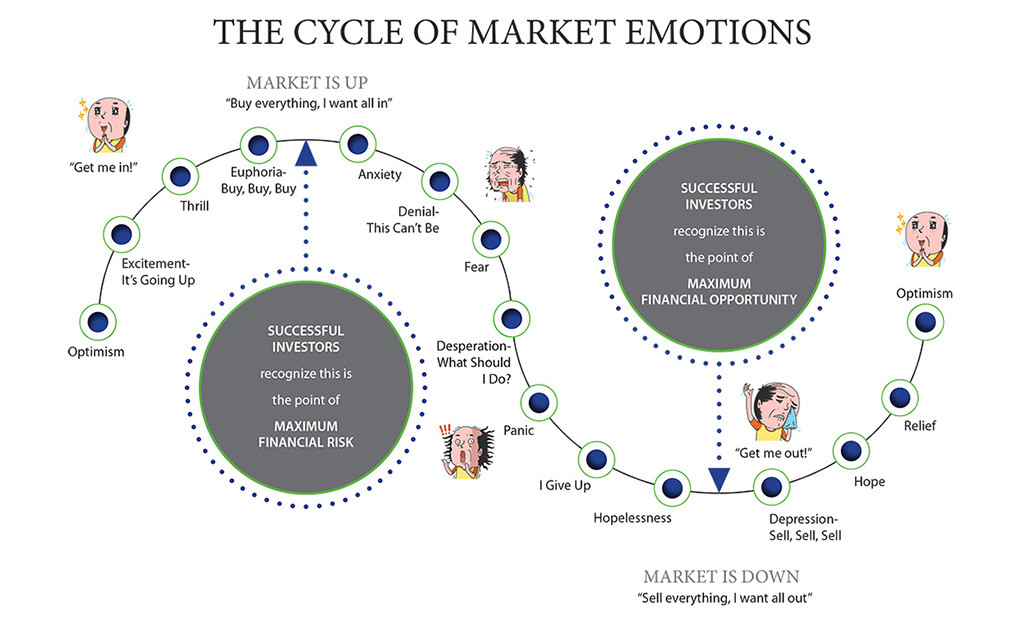
For a long-term fundamental investor, if you bought companies like Zoom, Teladoc, Mercadolibre, PayPal, or Square a year ago you should be enthusiastic about price today. They are trading at 30, 40, even 50% lower! These companies can be bought cheaper today with the fundamentals about the same today, if not better. It is important to understand the cycles of market emotions. We are closer to maximum financial opportunity than maximum financial risk. At this time last year market sentiment was about euphoria. You sell during those cycles to build your cash position, which is then best deployed in times like today.

Long-term investors should always try to ignore major macro events because they will always exist. There will be those that try and sell everything and get back in the market when things “calm” down. It is proven for the average investor, timing the market is nearly impossible and they often miss the boat. They end up leaving the market entirely or buying back in at a much higher cost average. The road might be bumpy in the near term but I think we will look back at this time as a great buying opportunity. I will take any short-term pain to receive long-term prosperity. As the great Charlie Munger once said, “If You Can’t Stomach 50% Declines in Your Investment You Will Get the Mediocre Returns You Deserve.”

If Investing is so Easy, Why is it so Hard?

Investing seems so easy. In 2010 a single Apple stock cost less than $10. If you had bought $10,000 worth of Apple Shares back then, today, it would be worth over $130,000. Seems so simple in hindsight however in practice, investing has been proven to be extremely difficult.

If you can start investing when you are in your early 20s, you should. Ask any great investor, they all wish they started sooner. Though, most people in their 20s are not even thinking about investing. Those that do get started likely do not have the emotional intelligence, patience, or discipline to let their investments grow.

Just now it seems Roman Reigns career in the WWE has reached its apex, being branded as the Tribal Chief in 2021.

I consider great investors like great pro wrestlers. A lot of wrestlers don’t hit their peak until their mid-late 30s. It typically takes 3-5 years of wrestling experience to even get in the WWE and another 3-5 years to get consistent airtime and opportunities. It is not so much athleticism, as athletes typically peak in their mid-late 20s but developing ring psychology requires years of practice and training.

Most investors in their 20s are intelligent enough to understand the technical aspect of investing. Warren Buffett has said many times that you do not need a high IQ to be a great investor. Being too smart might be a disadvantage in investing because it can cause you to be overconfident in an unpredictable environment. You need emotional intelligence and discipline to be a great investor. Remember, the stock market is an auction-driven market that is driven by human emotion. That’s why you will see stocks priced absurdly low and astonishingly high at times. These inefficiencies are how great investors can become wealthy.

We can reflect on Sir Isaac Newton, who is considered to be one of the most intelligent people in the history of the world, and his investing failure:

“Back in the spring of 1720, Sir Isaac Newton owned shares in the South Sea Company, the hottest stock in England. Sensing that the market was getting out of hand, the great physicist muttered that he ‘could calculate the motions of the heavenly bodies, but not the madness of the people.’ Newton dumped his South Sea shares, pocketing a 100% profit totaling £7,000. But just months later, swept up in the wild enthusiasm of the market, Newton jumped back in at a much higher price — and lost £20,000 (or more than $3 million in [2002-2003’s] money. For the rest of his life, he forbade anyone to speak the words ‘South Sea’ in his presence.”

Isaac Newton was a genius, but even he lost millions in the stock market

Humans are emotional beings. Humans often do not know why they make the decisions they make. Often it is based on snap judgments and acting based on faulty intuitive reads. When people see their investments decline by 50, 60, 70, 80, or 90 percent, the majority of people will start panicking. It is basic human nature to want to avoid pain and sell.

That’s why the buy-and-hold strategy is unrealistic for most people, due to faulty human wiring.

To beat the market, you have to divert from the market and think for yourself. There is nothing wrong with cherry-picking other great investors and buying the same stocks they buy. That’s easy. The hard part is to hold onto those investments and stick them out when it drops or to sell them when it seems like it is going to the moon. Investing is a constant process of inquiry. Great investors have to re-wire their brains and become comfortable with uncertainty. As great investor Mohnish Pabrai said, “fear and greed are very much fundamental to the human psyche. As long as humans drive buying and selling decisions in equity markets, pricing will be affected by these fear and greed attributes.”

The key to winning in investing is being emotionally resilient or having a mastery of your emotions. That’s one of the main skills needed to be successful in long-term investing. Believe it or not, the odds of being a successful investor are much better than being a professional athlete, a chess grandmaster, or even a top-ranked poker player. Games like basketball, chess, and even poker require more skill and less luck than investing. Only 0.08 percent of high school athletes will be drafted by an NFL team. Only 0.03 will make it in the NBA. Being a wealthy investor is possible and a realistic goal much more probable than a professional athlete, A-list celebrity, or a mega social-media influencer.

Being a great investor puts you in the minority. Some would call it an exclusive club, but you could also call it a lonely club. 8-9% of adults in the U.S would fit the definition of being considered a millionaire. The more wealth you build up, the more of an outlier you become. Being that wealthy requires you to have a different mindset than the crowd. The great investor is sitting inside a burning building while others are fleeing.

One of the biggest reasons why investing is so difficult is that it puts you in an entrepreneurial mindset, you need to get out of your comfort zone and embrace risk and long-term thinking. You need to take actions that go against what the majority is doing in favor of principled investing strategies. Look at Amazon, which takes much of its revenue and reinvests it into the business. The conventional wisdom is to build a large cash reserve for a rainy day however, a large cash balance is simply eroding over time. Why not use that cash to make your business more valuable? The same principles go with long-term investing.

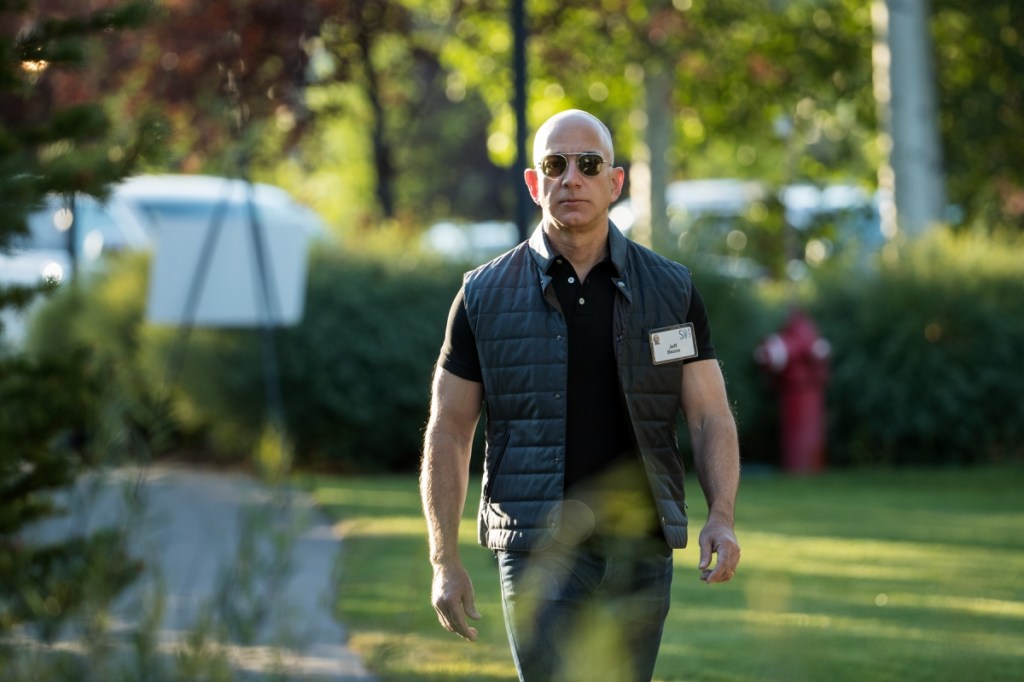
If you go read Jeff Bezos’ annual letter to shareholders, you can tell he built Amazon like a great long-term investor:

So, if the company is better positioned today than it was a year ago, why is the stock price so much lower than it was a year ago? As the famed investor Benjamin Graham said, ‘‘In the short term, the stock market is a voting machine; in the long term, it’s a weighing machine.’’ Clearly there was a lot of voting going on in the boom year of ’99—and much less weighing. We’re a company that wants to be weighed, and over time, we will be—over the long term, all companies are. In the meantime, we have our heads down working to build a heavier and heavier company.

Amazon’s letter to shareholders in 2000

Investing is an exercise of trying to evaluate a business and a. trying to buy it when it is undervalued and b. hoping its value will appreciate in the future. Seems rather simple however most people don’t even try to do this. They either contribute to a 401K or are passively investing in an index.

If you are investing in a fund, say a random U.S. Large Growth Fund, Apple might be one of the companies inside the portfolio, but it is only 1/296 positions inside the fund. If you really like Apple’s prospects for the next decade, the performance of that individual company has very little to do with the success of that fund. You are not evaluating individual companies, but the long-term prospects of hundreds of large growth companies, or a sector. This type of conservative strategy will net you average results. Better than not investing at all however you are minimizing your risks but capping off your rewards. That is the essence of passive investing, to produce average returns.

The best reasons to invest passively are the reasons to invest actively. You can make a lot of money following an index and netting mediocre returns. The same principles for passive investing are the same for active investing – Time and patience are your best friends. It can make big mistakes look very small over time and make small investments large over time. Many people fear picking the wrong stock; however, I know very few successful investors who only invest in a handful of stocks. Look at investing like drafting the best baseball or football team. In football, you don’t need to have 5 elite quarterbacks on one roster, so you focus on building the best all-around quality team. If you are building a great team, do you sign high school athletes with massive contracts? The answer seems obvious, yet some investors have a portfolio built on risky, unproven unprofitable companies. Much of your portfolio should be made up of quality long-term companies that have proven themselves as long-term fundamentally sound companies.

“As you would expect, however, not all of our important decisions can be made in this enviable, math-based way. Sometimes we have little or no historical data to guide us and proactive experimentation is impossible, impractical, or tantamount to a decision to proceed. Through data, analysis, and math play a role, the prime ingredient in these decisions is judgment.From Amazon’s Letter to Shareholders in 2005

In summary:

  • Ideally, you should be putting up the most money investing when you are young, when time is on your side, however very few people have the traits to commit to it long-term.
  • Most young people do not have a lot of money when they start investing and are not conditioned to think exponentially. In investing you can see 10,000% gains. In schooling, the highest test score you can get is 100%. The most you can get for a project is an A+, even if your work merited a higher grade. The modern education system conditions you to follow the crowd and be average, which explains why passive investing is popular.
  • Evaluating the value of a business can seem like a fruitless exercise that even the smartest of people are just guessing on. In a 2007 Berkshire shareholders’ annual meeting, Charlie Munger said, “we throw almost all decisions into the too hard pile, and we just sift for a few decisions that we can make that are easy. And that’s a comparative process. And if you’re looking for an ability to correctly value all investments at all times, we can’t help you.” Evaluating a business is a mix of art and science where exact answers are not realistic. You must use your best assumptions and judgments.
  • As Buffett has said many times, investing is the process of putting out money today to get more money back at some point in the future. Even though evaluating a company seems impossible, all investors have tools in their favor to become wealthy. Don’t think of investing as predicting the future but as a game of inquiry and thinking.
  • Most young investors have time on their side. You also don’t need to be an “A” student to be a great investor. Most investors are wrong more than they are right. A “D” student could make millions investing.
  • A risk management strategy implies that you are actually taking risks. If you are not invested at all and all in cash, for example, there are no gains, your cash balance is eroding by 5% due to inflation. If you are not taking enough risk, you are slotted to net mediocre returns.
  • Investing is a reflection of you and your financial goals. Some people look at investing as an opportunity to grow generational wealth. Some people look at investing as a sweetener in life, to protect and grow the wealth they already created.

My Top Investing Themes For 2022

As we head into the new year, I will look at the top investing trends for 2022. Currently, we are still dealing with the Covid-19 pandemic, but I predict by the middle or end of 2022, we should be shifting towards the end of the pandemic and transitioning towards an endemic. Gradually we will see fewer restrictions and more people will feel comfortable traveling and attending large gatherings again. This does not mean Covid-19 will go away, it will stay with us for a very long time. The virus will mutate and require annual booster shots. The virus will go through a stage called attenuation which means weakened, diluted, thinned, reduced, diminished. The pandemic may end, but we will never return to the old normal. International travel will take several years to recover. Some form of work-from-home will continue. Most importantly, most problems before the pandemic still exist, and a lot of them are getting worse.

The Good:

Demand for cruises has been unprecedented for 2022.

Demand for concerts and live events? Same thing. Concert tickets for Olivia Rodrigo’s SOUR tour sold out due to overwhelming demand. Tickets in San Francisco are being resold as high as $9,000.

The people who have money, are spending it, even with higher prices caused by a combination of inflation, low supply, and pent-up demand. In summary, consumer spending should be strong in 2022. I am optimistic about the U.S economy in 2022, more so than last year.

The Bad:

Inflation, supply chain disruption, and the labor shortage are still problems. These issues should not prevent you from investing, as there will always be some headwinds even during the best of times, but these are worth paying attention to. The labor shortage problem deserves a much greater deep-dive however I predict more people will return to work on the basis that they need money. Pandemic assistance will dry up, people will need an income to support themselves. Many people have found funds through being a content creator through onlyfans, youtube, TikTok, etc. But realistically for the average person, can they maintain that steady income stream in a non-pandemic setting? Social media is always evolving, you must be quick to adapt otherwise you become an afterthought.

When federal stimulus support ends, bankruptcies could pick up. The big lingering question is how much has pandemic assistance propped up families and businesses from disaster? We could soon find out. This reminds me of a famous Warren Buffett quote, “only when the tide goes out do you discover who’s been swimming naked.”

Economic inequality will get worse – If you are in cash, due to inflation, your money is eroding around 5% each year. If you do not own real estate and stocks, you will fall further behind. If you are not in a high-demand field like tech, the purchasing power from your wages will decrease. If you are in deep poverty or homelessness, the chances of recovering are not better. The poorest individuals will continue to fall further behind.

Mental health issues will reach a crescendo – This will affect everyone no matter what economic class, race, national origin, sex, religion, or age bracket you are in. The pandemic has left millions of people with PTSD and exacerbated preexisting conditions like depression. Even if you got a raise or in an industry where the demand for your services has increased, the work culture has become far more oppressive and stressful. There is no work-from-home for nurses, flight attendants, pilots, etc. This will take a toll on everyone’s mental health. We see it in stories with the record number of unruly passengers or doctors and nurses being assaulted by patients. What do you get with short-staffed employers dealing with packed concerts, restaurants, and mass gatherings? That is several bad headlines waiting to happen. Everyone already knows mental health issues are a problem and going to get worse, but I believe 2022 it will get to a point where it will start grabbing the spotlight from news media outlets as covid starts dying down.

And as predicted, hot-button partisan issues like gun violence, abortion, immigration, and health care will still be divisive.

Without further ado, here are my top investing themes for 2022:

E-Commerce

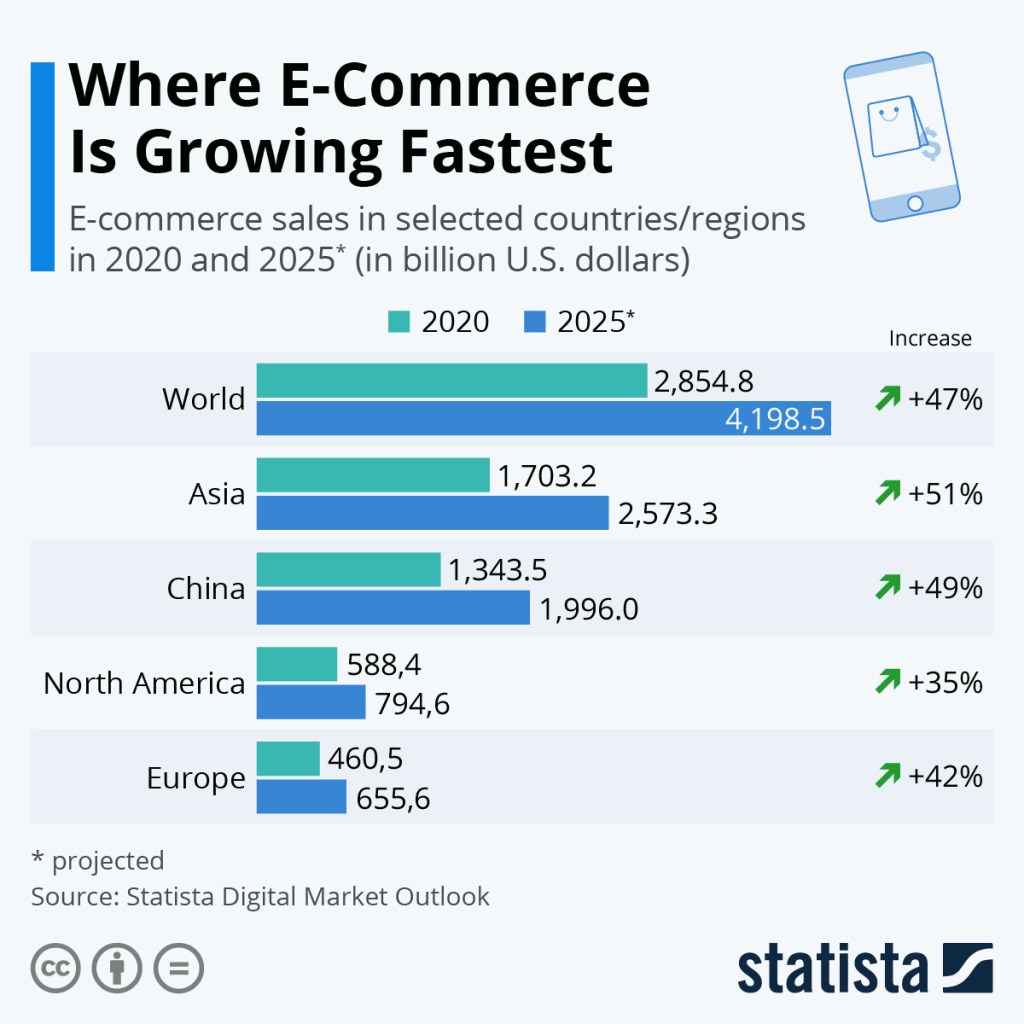
E-Commerce is growing fast and expanding everywhere. Every year we will be more tech-driven and E-Commerce will play a bigger part in our everyday lives. In no way is this a fad. The pandemic just sped up the growth cycle with increased online payment activity. We are seeing the acceleration of the trust and adoption of digital platforms globally. We will not be going backward.

Who do I like the most? Choose from the buffet list! I like the big players like Amazon, Alibaba, MercadoLibre, and Sea Limited the most. Even smaller players like Coupang and Jumia are intriguing.

The two companies I like the most are Amazon and MercadoLibre. With Amazon, you have its marketplace/retail business, which we know is still growing globally. Evercore ISI analyst Mark Mahaney, whose book I’ve just finished reading, called Amazon, “arguably the single best fundamental asset in Net-land.”

With Amazon you also get its cloud computing business Amazon Web Services (AWS), which is growing faster than its retail business. And then I am banking that they will find their next AWS. With Amazon, they always have their hands in different cookie jars. These are high-reward pet projects that can change the entire trajectory of the company. It could be AI-powered robots, a cloud gaming service, telehealth, who knows! And even if they do not find the next big growth segment of their business (which I predict they will), the company is still growing at a fast rate, the stock will likely do just fine. Picking Amazon is like picking Stephen Curry on your basketball team and getting his brother, Seth Curry for free.

Mercado Libre’s goal is to improve the speed of its deliveries so it can compete with Amazon’s delivery service

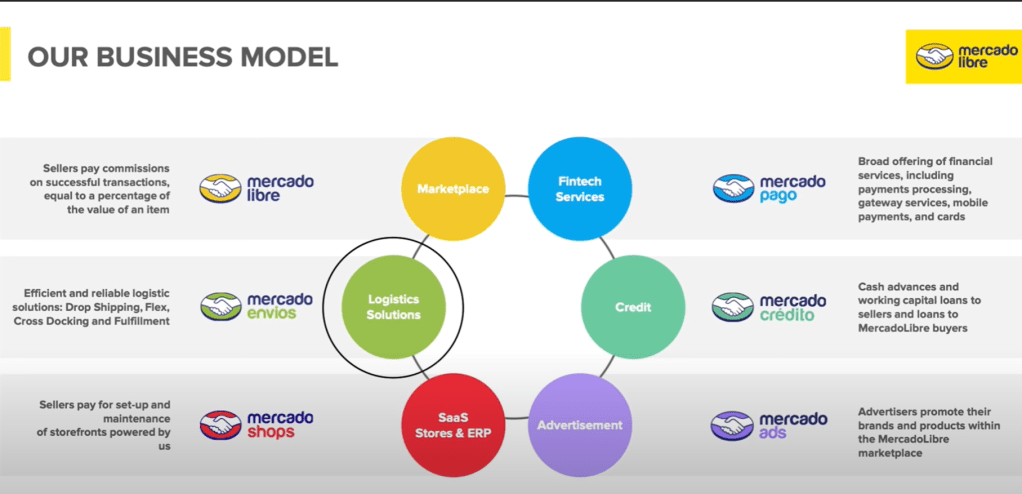
MercadoLibre is considered the Amazon of Latin America. They are in 18 different countries and expanding quickly. To understand why MercadoLibre is growing so quickly you must be able to differentiate the United States from Latin America. Many people in Latin America are unbanked. The postal system in Latin American countries is not as reliable as the U.S Postal system. Amazon, for example, can’t just open shop in Argentina and expect the same results in Texas. It takes several years to build a strong infrastructure. MercardoLibe has solved this by expanding from just its marketplace business and now has a fintech platform, credit service, advertising agency, and logistics division. They are building such a strong ecosystem they are becoming the PayPal (MercadoPago) and FedEx (Mercado Envíos) of Latin America.

More competitors will enter this space as it grows however this isn’t a winner-take-all battle. In the United States, you have PayPal, Square, Visa, Mastercard, Amex, Sofi, etc. There isn’t one dominant player. The total addressable market is massive. MercadoLibre right now is a big fish in a big pond. In the future, they will still be a big fish but in an even bigger pond. There are 33 countries in Latin America, the space is big enough for multiple winners.

Biotech

Field Trip Health recently opened their first US location in Manhattan Field Trip Health

Biotech had a terrible year in 2021 unless you were involved with the COVID-19 vaccine, like Phizer, Moderna, or Novavax. A lot of biotech stocks ended the year negative however I would expect that to change in 2022 as many of these companies can be bought at bargain prices. Companies like Gilead Sciences and Bristol-Myers Squibb are undervalued. Johnson & Johnson is one of the safest dividend stocks to invest in, and that stock has a 10-25% upside. These stocks won’t 10x, but they provide lots of safety and easy money. These are companies you can own for over a decade and not lose any sleep.

In regard to riskier long term plays, I really like Field Trip Health Ltd, a company that specializes in psychedelic-assisted therapy. So far, the results are extremely promising:

In the past three years, at least a dozen such facilities have popped up around the Puget Sound region.

“When we started seeing patients a little more than a year ago, I wasn’t sure what to expect in terms of volumes,” said Liana Ren, a nurse anesthetist who runs Lighthouse Infusions, a ketamine clinic in Kenmore. “The last couple of months … our schedule has been full.”

As ketamine clinics emerge in Seattle to treat mental illness, so does debate about safety and regulations

Field Trip Health is a similar clinic with locations in Toronto, New York, Chicago, Los Angeles, and Atlanta. Unlike Mindbloom, which went completely virtual in September of 2019, Field Trip offers an in-person ketamine experience at their spa-like facilities. Put The Wing, a Manhattan therapy office, and a yoga studio in a blender, and you’ll get the vibe.

Is tripping with a therapist the next big thing In mental health?

I envision these ketamine-assisted psychotherapy clinics as the next massage therapy for your mind. These clinics won’t be mainstream anytime soon, but I see this as a brand-new emerging market. Field Trip plans on opening 75 clinics by 2024. I see this as the newest innovation in mental health, and as mental health becomes more mainstream, the better for the psychedelic sector.

Consider in 2003, there were 9,870 Spa locations in the United States, now over 21,500. exist. The number of Americans practicing yoga grew by 50% in four years. I see too much positive news every day regarding Psychedelic therapy/treatment. More and more cities are decriminalizing psychedelics and psychoactive drugs.

Investing in psychedelics is still early in 2022, but I have dipped my toes in the water. I understand the skeptics and unfortunately, unless you have used these drugs, it can be hard to conceptualize the net benefits but ask yourself the first time you got a professional massage. I would guess most people liked it (I did) and will likely get another one in the future. I recently went to Mexico and got a synchronicity massage, which included amplified vibrations, pressures, and patterns. Bass vibrations rippled through the massage table. The experience I would say was quite an enjoyable experience. I view psychedelics in the same manner. It is not for everyone, but there is a high demand for these types of treatments and the market currently has very few solutions that work.

The Lululemon Lab opened its first New York City location in the NoHo neighborhood of Manhattan. COURTESY OF LULULEMON

E-Fashion Retail

I am bullish on the evolution of online fashion retail. Large retail chains like Macy’s, Nordstrom, Kohl’s were struggling before the pandemic and that is not going to change in the future. I would guess they will receive a boost when things open however, in the long-term I wouldn’t want to hold any of these companies. I am not saying all these companies will file for bankruptcy, however, online specialty retailers like Stitch Fitch, Revolve, and Everlane are growing in numbers. For traditional retailers to survive, they need to double down on digital transformation and social media, which means they will be playing catch up to companies like Revolve. They need to merry a high-touch customer experience, content curation, and personalization. If they cannot do that they will struggle as traditional retailers are carrying an anchor, empty stores, which online retailers do not have to deal with.

Retailers are in a very tough spot. Those that sell discounted brands have Amazon and Walmart hovering around them like a dark cloud. Luxury brands are very exclusive. It is nearly impossible to compete with brands like Louis Vuitton. Even Amazon, as powerful as they are, would have trouble selling luxury watches and competing with Rolex. That leaves many retailers needing to find their specialized niche and audience. Lululemon is the best example of a thriving retail store because their E-Commerce drives their company, not the stores. They also have excellent branding, reaching more customers yet still maintaining a luxury brand image. I could be wrong however companies like Nordstrom are operating on an outdated business model and unless they can pivot, very fast, they could go bankrupt or go through another decade of stagnating growth.

I Lost $400,000 On Alibaba: Bad Robinhood Bet

I Lost $400,000, Almost Everything I Had, on a Single Robinhood Bet

This is my reaction to a recent article on Vice about a 26-year old retail trader who lost nearly all his life savings on a single Alibaba call option.

“I put chump change, like three grand, into crypto, when I only had five grand to begin with in 2017, and I lost all of it. But I was seeing everybody making money hand over fist, and I wasn’t. I work in tech, and a lot of my colleagues were worth, like, $10 million.”

The price of bitcoin fluctuated in 2017 from around 900-19,700. If he had bought bitcoin or any other cryptocurrency, even at its highest price, and just held it, he would have at minimum, a 150% gain today. Anytime someone says they “lost it all” in the stock or crypto market, ask that person specifically what they did. If you get a clear answer, what the trader did had nothing to do with long-term investing or just the classic buy and hold strategy. This trader made a high-risk leveraged gamble.

This trader referred to three grand as “chump change.” I personally would never refer to three thousand as chump change. With the power of compounding interest, or just appreciation, 3,000 can easily turn into 10,000-20,000 in a short matter of time. This is one of the most fundamental rules of finance, respect money. The most powerful thing about money is that it gives you the ability to gain control over your time. A trade like this does not show a great deal of respect towards money.

My job involves a lot of researching companies and trying to understand business and economic models. I like to read a lot, and there’s a lot of books on investing. 

What he did had nothing to do with investing so maybe he is confusing investing books with books on trading or options strategies? For most investors, the best books on investing are more psychological/philosophical based. A lot of the strategies involving technical-based analysis investing are not applicable for the average person. It is geared more towards short-term trading, too complicated, or once again, not related to fundamental long-term investing.

Long-term investing has been lumped in with day/swing trading, which is unfortunate. They have become interchangeable terms. Investing is a powerful tool to create wealth. Trading mimics gambling. Each requires a different skillset/mindset. Many of the principles of trading stocks run counter to long-term investing. It is important to know the difference. You could not say you are a vegan and then start eating meat. A lot of traders say they are investing, which is not true.

It didn’t start with Alibaba. It started with a $5,000 bet on AMC. Then the $5,000 became $15,000 when I bet on something else, then it became $50,000 when I bet on silver. And that’s when I was like, Okay, I’m done with this. Now I want to buy a safe bet. And the safe bet was Alibaba. Then I just went all in on this one single stock option: The $200 strike price call option on Alibaba. ​​I would describe a call option as a leveraged bet on an underlying stock, which helps you increase the upside (or downside) of the bet you’re trying to make. I initially invested $300,000 in February, basically every single liquid asset in my account. 

Buying a call option is quite different from buying the underlying stock. I am not an expert on options trading; however, it is something a beginning trader should not dabble into. Even if you have experience in the market, options trading should only make up a small percentage of your portfolio.

With investing, you have time on your side. It is one of the most powerful forces in investing. It can make small investments grow big and make big mistakes fade away. When buying call options, you lose having time on your side. If your call option cannot get above the strike price before the expiration date, you lose your entire investment. Often when you have time pressure, your ability to make a clear decision can become foggy.

The one thing I really hate about buying call options is that the trader could be right about Alibaba and the price of the stock going higher. However, he has to be right about the price in a certain timeframe, otherwise, he’s toast.

“So I was like, Hey, this is gonna rebound. And as my salary came in, I saved another $100,000. So in July, I put in another almost $100,000. I basically transferred all the liquid cash that I had and maxed out my account. If my company had not paid me at the end of July, I wouldn’t have made my rent payment on August 1.”

This trader made some obvious mistakes that all investors can learn from. One is not taking a risk that can wipe you out completely. Gains are important however you must survive to succeed.

I like to think of investing as gambling, but with the odds in your favor. Imagine making a $1,00,000 bet that the Dallas Cowboys will win at least one Super Bowl with a twenty-year time horizon vs making a $1,00,000 bet that the Dallas Cowboys win at least one Super Bowl in the next two years. One bet gives you a much higher probability of success and is less risky.

“I sold and shut down my Robinhood account in October, right before my birthday. I decided I don’t want to have this hanging over my head. [Editor’s note: He walked away with under $20,000.] The day I sold it, I was like, You know what? I ****** up. It was a mistake. But clean slate, dust yourself off and move on. I felt better when I sold, much better actually.”  

One positive aspect of this article is that this trader learned from his mistakes. It does not appear he has a six-figure income yet was able to save nearly $400,000. Now that is impressive. He is young enough to recover from this however I will not mince words, this was a bad mistake that will likely set him back a few years or more.

I do believe right now Alibaba is an undervalued stock. The actual value of the stock is probably around 190-210. It is a company with strong fundamentals, a healthy cash flow, and consistent revenue growth. In 5-10 years, I can easily see the stock price being in the 600-800 range. If he had just bought and held the underlying stock, this would be potentially a million-dollar missed opportunity.

LESSONS TO BE LEARNED FROM THIS:

  • When you have a net worth of roughly $100-500K, you have wealth, but you are not actually wealthy yet. At this net worth bracket, it really is not the time to be buying a Tesla or Rolex. It also is not the time to be making wild leveraged bets. Remember, this trader did not go all-in on a single stock, he went all-in betting on the price of a single stock in a given timeframe. This is a type of bet someone with a net worth of $100 million can make without losing sleep. This trader had an easy path to become a millionaire at a young age, and now is kind of starting from the bottom again.
  • Don’t use Robinhood as your main brokerage account. Brokerages like Robinhood gamify investing. It makes it feel like a game rather than real-life. Take this seriously, you are using real money. Treat managing your portfolio like an actual job. It makes it feel more real and less like a game.
  • Be Like David Puddy. Famous investor Mohnish Pabrai was recently interviewed about what it takes to be a great value investor. He said great value investors are people that like to watch paint dry or look at the back of an airplane seat for long periods of time (like David Puddy). Patience is the most important trait to be a successful investor and unfortunately, most people lack this ability. They need stimuli or action. For most people, investing is boring despite it being a proven way to become extremely wealthy. Gambling is more exciting and attracts more people despite it being a proven way to lose your money. One analogy I would make is farming vs hunting. For most people hunting is far more exciting than planting a few rows and tending to them carefully however farming has been proven in the long-term to be a more efficient way of producing food.
  • Find the order within chaos. Friedrich Nietzsche once said “Whoever fights monsters should see to it that in the process he does not become a monster. And if you gaze long enough into an abyss, the abyss will gaze back into you.” I have said this many times however I will repeat myself again, investing is psychological. The market will eat you alive if you have the wrong mindset. Focus on being an island of stillness in a flow of treacherous waters.
  • There is no need to pile on this one trader. There is a famous quote from Ian MacLaren, “Be kind, for everyone you meet is fighting a hard battle.” He made a mistake but seems to have enough self-awareness to learn and grow from this. These painful lessons can be viewed as teaching moments. It is better to learn a “lesson” like this now instead of blowing 4 million on a single-stock call option in the future.

AOC is a Bad Role Model For Young Women

WASHINGTON, DC - JANUARY 09: U.S. Rep. Alexandria Ocasio-Cortez (D-NY) passes through the National Statuary Hall January 9, 2020 at the U.S. Capitol in Washington, DC. (Photo by Alex Wong/Getty Images)

According to her financial disclosure report, Alexandria Ocasio-Cortez has a checking account, brokerage account, and a 401(k) plan through the National Hispanic Institute. All three accounts reportedly have between $1,001 and $15,000 each. You can view the PFD of the disclosure report here. According to the House of Representatives, she has a salary of $174,000 a year.

For someone that lives in a swanky D.C. apartment building and drives a Tesla, how does she have so little in financial wealth? Alexandria Ocasio-Cortez serves on the House Committee on Financial Services. She should have the knowledge and understanding of the importance of investing early in life. Of course, a lot of people AOC’s age have little, or nothing invested, but the majority of them do not have access to the same people and information that the congresswoman from New York has.

AOC is a star; she has made it. Whatever glass ceiling that was above her, she broke through it. She did not succeed through just luck or happenstance. She has superstar-like qualities and traits that should not be dismissed. But someone in her stature, with nearly 13 million Twitter followers, serving on the House Committee on Financial Services, should be held to a much higher standard.

On average, Latinas in the U.S. are paid 43% less than white men and 28% less than white women. A lot of young Latinas look up to AOC and for good reason. Instead of talking about eliminating student debt or creating a public banking option, she should also be discussing the importance of investing early. In general, if more people invested early, issues like a national hourly wage, or crushing student loan debt, would not affect as many people as it does now. I am not here to discuss if AOC is right or wrong on the hot button issues. These are prominent issues that need to be addressed but given how easy it is today to open a brokerage account, and how easy it is to invest in an individual stock or an index fund, AOC should set a better example for the millions of women and girls that look up to her.

Investing is something people can do within their power right now. Due to inflation, having cash right now is very dangerous. In a recent interview, Ray Dalio said, “Cash is not a safe investment, is not a safe place because it will be taxed by inflation.” Eliminating student debt and raising the minimum hourly wage will not dramatically lift people out of poverty. Investing early and letting the magic of compounding interest do its thing are proven winning strategies that can create life-changing wealth. AOC may become extremely wealthy without investing however her situation will not be so easy to replicate for the millions of her supporters.

Ignore the Noise: Invest Like the Patriots

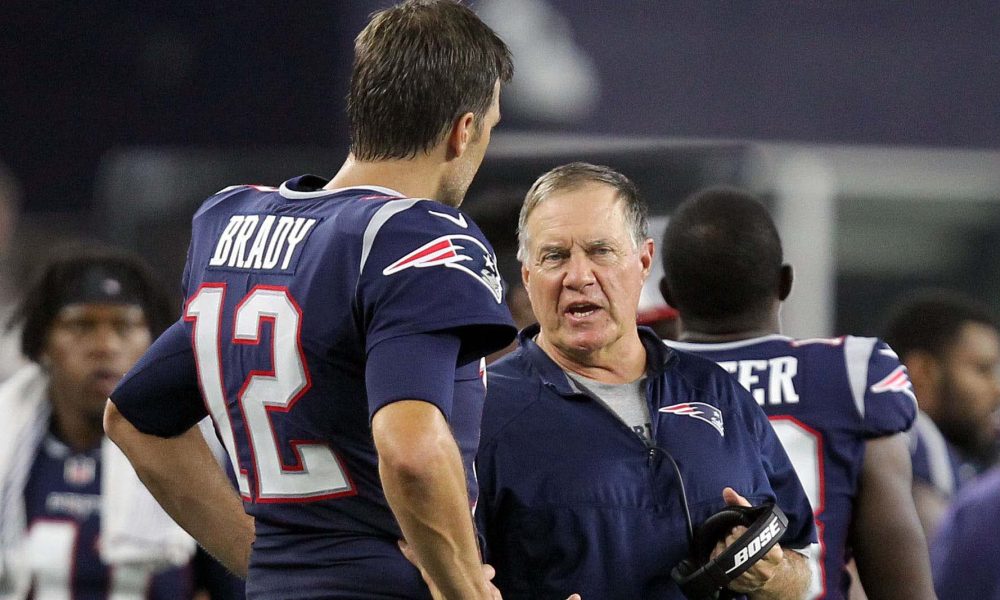
“We’ve always said, ‘ignore the noise.’ So living by, and practicing that, rather than ‘this is our rallying cry, this is our motivation,’” Tom Brady said. “The reason why we win was not because someone insults us. The reason why we win is we ignore it, and everything everyone says, and focus on the tactical things that matter.”

The New England Patriots have been among the most successful sports franchises in the past twenty years. The Patriot’s formula for success is fairly simple yet nearly impossible to replicate. They don’t follow the herd or what is currently in vogue. In fact, the Patriots are often the team creating the trend, with other teams copying them. In regards to managing their roster and game planning, they have a set of principles that they tend to follow every year:

  • Re-sign players to fair market deals, if not, trade, release them or let them walk
  • Accumulate lots of draft picks despite not having a top-ten draft pick since 2001
  • Trade for players with favorable contracts who provide high-reward, low-risk.
  • Draft and sign players who can play multiple positions.
  • Prioritize drafting and signing players who are under the radar. I am unsure if any other team finds more value in late-round draft picks and undrafted free agents.
  • Open-minded: The Patriots will tweak and improvise on schemes.

All of these principles/concepts seem fairly simple, yet in reality, very difficult to implement in real life. Mike Tyson said, “Everybody has a plan until they get punched in the mouth.” If you have a plan of running into a burning building and know that is the right plan yet see everyone running away from the burning building, you will probably question that original plan.

The Patriots are unique. They won their seventh straight victory on Monday night against the Buffalo Bills by attempting only three passes. The last team to do that was in 1974. “We don’t sit around listening to what everybody else says,” Belichick said. “With all due respect, I mean really. Look, we have a job to do. We’re focused on doing that job. We’re not going to sit around and listen to what everybody else says. We try to do the best we can.”

After the win, they celebrated but in a very workmanlike manner. They don’t get too high after victories or are too low after defeats. This contrasts with teams like the Detroit Lions, who won their first game of the season and celebrated like they had won the Super Bowl.

Patriots celebrate a win over the Bills:

Lions celebrate a win against the Vikings:

You don’t see bearhugs with the team owner and coach or choreographed dance celebrations in the Patriots locker room. They tend to do things differently. Humans are generally hard-wired to want to belong to a group. Back when humans were all in tribes, this was necessary to survive. The Patriots have been great for so long because they have been able to turn off the noise and do it the Patriot Way.

The Patriots adhere to a specific process that has created a long-term successful winning strategy. The process is not fixed but dynamic, which has safeguarded them from falling out of contention. If the Patriots were a stock, they would be the best-performing company in the past twenty years. They have been the standard of the NFL. Most importantly, the Patriots do not follow the herd. As Charlie Munger once said, “crowd folly, the tendency of humans, under some circumstances, to resemble lemmings, explains much foolish thinking of brilliant men and much foolish behavior.”

Being a great investor requires turning off the noise. This doesn’t mean being a contrarian but not following the herd and executing your own set of procedures. There are some principles that I try to implement in my own investing strategy.

  • No matter how bullish the market is, a good portion of my portfolio is in safe and reliable stocks. In times of euphoria, I do not buy, instead, I sell and build on my cash position.
  • No matter how bearish the market is, a small-medium portion of my portfolio will go into higher-risk higher-rewards stocks. In times of despair, I start deploying my cash into assets.
  • Often our performance is based on simply holding a stock, not buying or selling. When there is uncertainty in the market, the best thing to do is nothing and be patient. Investors often overreact and panic. I try to ignore the noise. There is a reason why it is said patience is a virtue.
  • Margin contracts, buying on credit, and leveraging assets to buy or short the stock market are high-risk.
  • Although it can be difficult to determine when to buy a stock, I would rather buy a stock at its 52-week low than its 52-week high. If a stock is at or near its 52-week high, there is a good chance you will be allowed to buy it at a much lower price if you wait.
  • I never go into buying a stock thinking I will hold it for a short time period. I generally buy a stock with the plan to hold it for at least 3-5 years. This will save lots of money in tax advantages.
  • Never take a risk that can wipe me out completely.
  • Take simple steps to diversify.
  • Look for founder-led companies. Although not all founder-led companies succeed or are good investments, companies still led by their founder or founders tend to have an intrinsic edge over non-founder-led companies.
  • Every month try to read a book related to investment strategy.
  • Create my inner circle for investing counsel and advice. With social media, this is a lot easier to do today. I am not looking for stock pick recommendations, more so understanding the thesis and formulation for certain investing decisions.
  • Stay neutral and remain calm. Munger once said, “heavy ideology is one of the most extreme distorters of human cognition.” Keep your politics, religion, and ego out of your investing philosophy. Safeguarding your emotions will prevent you from buying in bubbles and selling during a panic. This, perhaps, is the most difficult part of investing: acknowledging and overcoming your own cognitive bias.

This is not a complete list, but I have found this framework to work for me.

Why The Middle Class Is Broke In One Chart

“Don’t need the cash,” Elon Musk tweeted. “Devoting myself to Mars and Earth. Possession [sic] just weigh you down.”

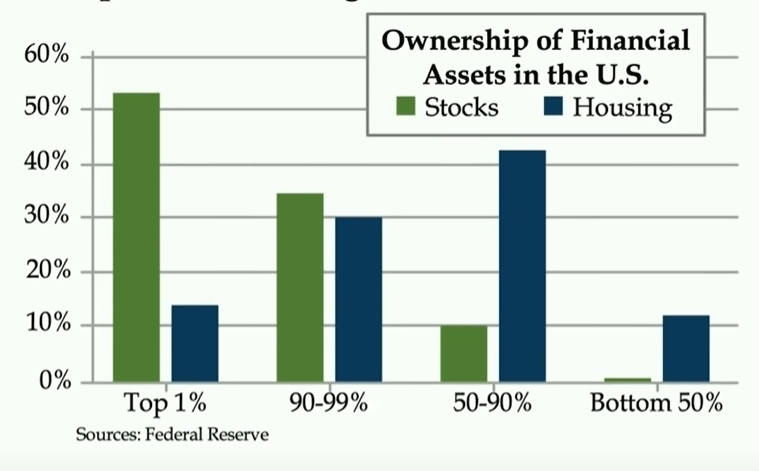
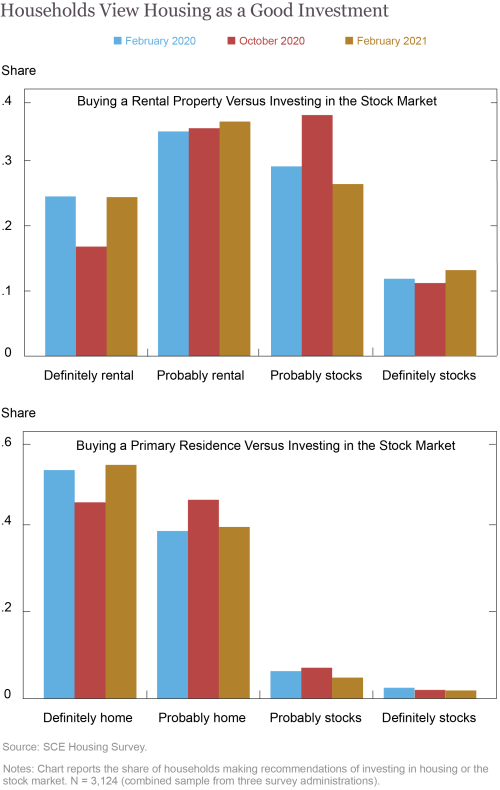
Why are the majority of Americans so poor? This chart shows they have too much exposure tied up in housing and not enough in stocks. The wealthiest Americans show much higher ownership of stocks and significantly less in housing.

The irony is that when you ask most Americans why they don’t any stocks, the most common answer besides not having enough money is that they are too risky! Unfortunately for the majority of Americans, not having exposure to “risky” stocks makes them vulnerable to being wiped out.

Two solid investing rules I learned and follow are;

  1. Reduce or eliminate debt: Avoid leverage, and beware of excessive expenses.
  2. Requires a safety of margin: Be an informed realist but do not allow your awareness of risk to become too fearful, paranoid, or pessimistic.

Sound/simple advice, yet it is something a lot of people do not follow. There are some common reasons why having most of your wealth tied up in housing is a bad idea. I will go over a few key bullet points:

  • Expenses: Property taxes, homeowner’s insurance, mortgage insurance, flood insurance, earthquake insurance, maintenance, repairs, renovations, acquisition costs, realtor commissions, etc. With stocks, you generally have none of this. Also, property taxes and insurance are not fixed prices and are likely to rise over time.
  • Debt: Although you have many pros with getting a low-interest mortgage, it is still debt.
  • Time: The time spent on buying and selling homes is much longer than buying and selling stocks. Even if you are flipping houses, it’s a much longer process than going online in your brokerage account and buying a stock. More sweat equity is involved with housing that requires your time and physical presence.
  • Mobility: If you own a home, you cannot just move and bring that house with you. Of course, you could rent out your home, which can provide a monthly income, but this can take up more of your time and expose you to landlord-tenant risks. Many cities have passed fair housing laws that make owning a house much less lucrative for a landlord.
  • Lack of education/preparedness. 64% of millennials have regrets about buying their current home. When you hear people say they don’t invest enough because they do not know enough about stocks, that somehow doesn’t apply to housing as so many millennials have buyer’s remorse yet still feel an obligation to buy a home. Just because something is tangible doesn’t make the process easier.

Per a study from the Federal Reserve, 90% of respondents preferred owning their primary residence rather than investing in the stock market.

Yikes.

I hate to say it, but the majority of Americans have it wrong. This keeping up with the Joneses’ mentality definitely explains why a wealth gap exists. Based on statistics and charts, the bottom 50% owns about the same amount in housing as the top 1%. Flipping it the other way, the majority of Americans own such few stocks.

It seems like I am completely railing against homeownership, but I am not. Like with stocks, if you can buy a home at a fairly-priced entry point, I am all for that. That being said, the amount of sweat equity involved in housing can mute the actual benefits. I also have trouble seeing any property that can net the same return as Tesla, which earned a 2,719.81% gain five years ago, or Apple, which has a 403,425.00% all-time return.

The reason many people buy homes has nothing to do with it being a good investment, as many other external/internal factors exist. For some, buying a house is an aspirational purchase. Buying a home can be seen as a sign of financial success but not actual wealth. The question you have to ask yourself is, would you rather appear wealthy or actually be wealthy?

I also believe many people have a cognitive bias against non-hard assets. This person’s profile typically finds tremendous value in housing or gold (It has value because I can feel it). If that person does own any stocks, it is in companies like Boeing or Caterpillar. They see the value in manufacturing, semiconductors, and commercial aircraft carriers, not so much in social media or e-commerce. Since they did not grow up or live on the internet, they have trouble finding the true worth of a company like Amazon or Facebook. They most likely have determined cryptocurrencies to be a scam. I would say this type of mindset is outdated, and as technology advances, it could leave millions of Americans desperately in the dust.

People need to invest more in stocks or invest anything at all as many people have zero invested in the market. Housing can be a valuable tool in growing your wealth, but I would caution anyone that concentrates their entire portfolio into it. As Zillow learned the hard way, flipping homes successfully depends on what local market you are in. Unless you are committed to getting into real estate/owning multiple properties as a career pathway, most people are better off investing.

Luxury Fashion Is Back In Full-Force

“The Great Gatsby”

Luxury Fashion is back with demand building and the pandemic easing. From a recent fashion report from ReportLinker:

The luxury fashion market size was valued at USD 110.64 billion in 2020 and is expected to reach USD 153.97 billion by 2026 growing at a CAGR (Compound annual growth rate) of 5.66%.

The following factors are likely to contribute to the growth of the luxury fashion market

Leveraging augmented reality
• Growing inclination towards sustainable products
• Internet shaping purchasing behaviour
• Increasing acceptance by millennials & Gen Z population
• Growing high net worth individuals
• Growth in travel & tourism

This shouldn’t be at all surprising. The pandemic slowed down the personal luxury market however the demand never went away. It was forcefully bottled up and suppressed but as things open up, we will see spending dramatically increase. This pent-up demand will likely lead to violent upward spending on luxury goods. New customers are buying and existing customers are buying more. Luckily for premium luxury brands, they are somewhat inflation-proof. If a consumer has already decided to spend $500 or more on a handbag, is increasing the price by 5-10% going to slow down spending? I do not think that is the case.

Are the Roaring Twenties back?

The numbers:

Global consumer spending on personal luxury goods, including the latest sneaker trend or design collaboration, is forecast to spike by 29% this year, to 283 billion euros ($325 billion). That’s a return to 2019 levels and a turnaround from the gloom of the 2020 pandemic lockdowns that shuttered stores and halted international travel.

U.S. consumers have at least temporarily supplanted the Chinese as the biggest spenders, accounting for one-third of all sales this year, compared with about 23% by Chinese shoppers, who were on par with Europeans. That trend is expected to invert by 2025, with nearly half of all spending by Chinese consumers, just over 20% by Americans and 18% by Europeans.

US shoppers outspend Chinese to restore luxury market

Revolve Group (NYSE: RVLV): Revenue was up 62% over the prior year:

Revolve Group Announces Third Quarter 2021 Financial Results

Capri Holdings Limited (NYSE: CPRI): The Parent of Versace, Michael Kors, and Jimmy Choo, Revenue was up 17% over the prior year:

CAPRI HOLDINGS LIMITED ANNOUNCES THIRD QUARTER FISCAL 2021 RESULTS

Tapestry, Inc. (NYSE: TPR): The Parent of Coach, Kate Spade, and Stuart Weitzman, Revenue was up 26% over the prior year:

TAPESTRY, INC. REPORTS FISCAL 2022 FIRST QUARTER RESULTS

Revolve is the biggest position in my portfolio. It provides travel, live events, high-end fashion, data, and tech all-in-one. I kind of view it as if Instagram and Amazon had a baby. Revolve’s business model is designed to not miss trends, giving it a massive edge over other luxury fashion companies.

I view Tapestry as greatly undervalued. I invested heavily in this company because of its increased penetration in China, digital sales/growth, and re-branding towards millennials and Gen Z consumers. If the company continues to execute, I have no doubt the stock will soar past all-time highs before 2026. I have so much confidence in this happening, once it does hit a new record-high I will buy and ship any item under $500 on Coaches website to one random subscriber of this blog completely free as a thank you.

Sometimes the market provides you with a very easy opportunity to make money. In a sports comparison, this would be like bunting against the shift. The defense is giving you a free base hit, so take it. Increased consumer spending on luxury fashion is one of the easiest consumer trends to predict after the pandemic. I will gladly take advantage of what the market gives me. Thank you!

Is Cardano (ADA) Blockchain 3.0?

There is the potential of using smart contracts to incentivize coffee farmers to adopt more productive farming practices. Coffee is Ethiopia’s largest export, and improving this industry would add massive societal benefits.

Cardano has become my favorite altcoin. I consider Bitcoin and Ethereum the blue-chippers of cryptocurrencies however Cardano may be the least speculative out of all the altcoins.

To explain better Cardano, I will try to explain what it is. Three full-time organizations are working on Cardano:

Cardano Foundation

IOHK (Input Output Hong Kong)

EMURGO

Cardano is viewed as many as blockchain 3.0. A blockchain is simply a chain of blocks of information. You can kind of look at it like Wikipedia.

There are three main aspects about a blockchain you want to know about:

Security – Defined by its consensus mechanism or how participants in the network come to an agreement about a certain truth or record that should be recorded in that particular block of the blockchain. For bitcoin, its consensus mechanism is called proof-of-work. Computers have to do a lot of work called mining in to prove that they have the right history or data in the blockchain. The proof of work algorithm is highly effective and secure however it is slow and consumes a lot of energy. That’s why when many people think of bitcoin mining they think of these odd-looking computers or mining rigs.

Scalability –  How many transactions you put through the network, how much data can you store on it, how big can the network get and how many people can it reach.

Decentralization. At the protocol layer, decentralization means that anyone can openly see the code that they’re running; what’s in the protocol, what it means, and that people can suggest changes to the protocol. At the next layer, the network layer, decentralization means that people who want to can easily and cheaply run nodes, put their transactions onto the network, and validate transactions of others.

Blockchain 1.0 technology is the transfer of decentralized money between two people without a middle man. This is what we see with Bitcoin. There is not much else to this technology, just that it works.

Blockchain 2.0 technology adds smart contracts and has much more conditions than simply a transfer of money. This is what we see with Ethereum. Cheaper and quicker than Bitcoin.

Blockchain 3.0 technology increases transfers per minute and utilizes the proof of stake protocol. This is what we see with Cardano, which uses the proof-of-stake model, which follows the ouroboros protocol: “Proof-of-stake answers the performance and energy-use challenges of proof-of-work, and arrives at a more sustainable solution. Instead of relying on ‘miners’ to solve computationally complex equations to create new blocks – and rewarding the first to do so – proof of stake selects participants (in the case of Cardano, stake pools) to create new blocks based on the stake they control in the network.

Cardano is still in the creation phase of a crypto lifecycle so it is still very much volatile and speculative. Cardano’s development process is divided into five different eras: Byron, Shelley, Goguen, Basho, and Voltaire. These five eras make up Cardano’s roadmap.

My favorite aspect of Cardano is its Africa strategy which you can read more about here.

The reason why I invested in Cardano, is because I believe the project has substantive value. There is a story. The Africa strategy focuses on banking the unbanked in underdeveloped countries. This is why blockchain and cryptos have value. Traditional banking does not work for everyone, it is not considered universal banking. Imagine if internet routers were not backward compatible or if they were only compatible with one type of modem? How many fewer people in the world would be able to connect to the internet? Even in developed nations, we see people or businesses being unbanked. If you are starting a cannabis business, even in states where it is legal, most banks don’t offer services to these types of businesses. Or take example strip clubs, imagine how much easier transactions would be if they accepted crypto? It would be less expensive, faster payments, and more privacy for clients.

The other reason why I could see Cardano exponentially grow in value is that it is more sustainable than Bitcoin and that is the long-term social trend happening in our country. 54% of teens consider their carbon footprint when making a purchase. The most important social/political issue for Gen Z is the environment. There are thousands of cryptos in existence right now. The ones that will survive are the ones that have the network effect and actual value. I mentioned scalability earlier and Cardano has the potential to be more technically and socially scalable than Bitcoin and Ethereum.

I try to apply the same principles for long-term investing in stocks with cryptos. These are assets to hold in the long-term as they appreciate in value. A lot of people will refuse to even acknowledge cryptos as useful until it is fully mainstream. Remember in the 90s there were smart educated people that thought the internet was a fad. People like Jeff Bezos and Elon Musk were laughed at in business meetings. Being long on volatile assets can minimize your risk and provide exponential growth. Even having a rudiment understanding of cryptos or the blockchain puts you at a significant leg up over the majority of the population in regards to investment opportunities.

If these terms are foreign and make no sense, I completely understand. I am a novice in this space as well. This is early-stage tech. A lot of this terminology is still being defined and there isn’t yet standard terminology in the blockchain space. One important investing rule is to find order within chaos. Cryptos are extremely volatile because since it is new, you will see a lot of speculation. The space is filled with a lot of people who got lucky or believe they can forecast future prices or events with certainty. No matter how smart you are, in certain situations, smart people can make very stupid decisions. The Dunning-Kruger effect, coined by the psychologists David Dunning and Justin Kruger in 1999, is a cognitive bias in which poor performers greatly overestimate their abilities. I would be skeptical of those forecasting prices of any crypto. A famous economist John Kenneth Galbraith once said, “We have two classes of forecasters: those who don’t know and those who don’t know they don’t know.” My best advice would be skeptical, focus on the story and learn about the fundamentals, enough to want to keep learning more but open-minded enough to take advantage of new and exciting opportunities.

Is Lemonade a Miracle Investment Opportunity?

The stock market is a device for transferring money from the impatient to the patient.” Warren Buffett

Lemonade is a very intriguing company because it is disrupting the insurance industry. Lemonade is less than 10 years old yet it is competing with legacy insurance companies over 100+ years in the business! Although they are unprofitable and on the higher risk of investments, I believe the risk-reward profile is justifiable given the rewards are 5-10x, possibly much higher. I will hold the stock for several years may be much longer. I understand the insurance industry isn’t going to change overnight and that’s not something people want to hear who have made massive gains in cryptocurrencies or meme stocks. With a little patience, I think Lemonade is worth holding in an investor’s portfolio.

Competitive Advantage: Artificial Intelligence.

AI, Forensic Graph Network, behavioral economics, machine learning, data points, etc. Basically, this is Lemonade’s secret sauce. I don’t want to get so much in the science of this competitive advantage but just that Lemonade is AI-powered while the majority of their competitors are not. The thesis for Lemonade is their AI better assesses risk, lowers loss ratio, creating a more efficient business model, which will eventually lead to higher growth and profit margins.

Network Effects

The term network effect refers to any situation in which the value of a product, service, or platform depends on the number of buyers, sellers, or users who leverage it. Typically, the greater the number of buyers, sellers, or users, the greater the network effect—and the greater the value created by the offering.

There are tons of examples of how network effects work. Companies like Facebook, eBay, Amazon, or Google are valuable because a lot of people are on the platform. The fewer people in their ecosystem, the less valuable the company becomes.

So is there a network effect happening in Lemonade? I believe so:

Lemonade ranks highest for Renters Insurance for 2021 in J.D. Power Study. There are some key nuggets in this study. Three of the biggest reasons why people stick with a certain insurance company long-term are trust, good service experience, and convenience. Price is obviously important but not the main driving factor for sticking with an insurance company.

Through Lemonade’s giveback program they donated $2,303,381 to 65 nonprofits in 2021, more than double from last year.

From my conclusion, Lemonade’s AI is creating a network effect and the proof is in their high customer growth rate. Another thing I like about Lemonade is its high customer ratings. Owning a Lemonade policy myself, I have to say the process was convenient, easy, and fast compared to going with a legacy carrier like State Farm or Allstate. This customer-first-centric business model goes into the premise if you create a company that provides a superior experience, consumers will better trust the company and be willing to pay more. Luckily for Lemonade, it won’t be that hard to win in this area. Who do you know that passionately likes their renters or car insurance company? The fact Lemonade donates part of your unclaimed premiums to charities provides that good feeling deep inside you typically never get with an insurance company. Through Lemonade’s giveback program, as their network grows, so does their social impact. More policyholders equal more revenue plus more good for society. It’s a rather genius business model if you ask me.

I believe in order to be a good investor you have to have your chips on the table. You are typically not going to get massive returns after a stock has made its big move. With Lemonade the hype and momentum are justified although the insurance industry is a bit slow-moving and lacking innovation. Those investors that are patient could see massive gains. Every additional Lemonade policyholder adds value in an exponential way. This is the network effect in play. When something has a network effect it is a rule and law that cannot be broken. Legacy insurance companies have their own network effect however there are three ways to stop a network effect: government regulation, technological failure, and significantly better competitor arriving. I believe Lemonade is that competitor that will lead consumers to swap out their insurance policies. Given how big the insurance space is and depending on how well Lemonade executes and harnesses its network effect, I could see this growing from a 2-3x bagger to something even more incredible in the range of a 10-20x bagger.