Don’t You Worry, Stocks Will Be Okay

Searches for the term ‘recession’ have spiked in June and July on Google Trends. More and more “experts” are calling for a recession; some say even a great depression. So many things are going wrong in the world:

  • Inflation
  • War in Ukraine
  • Gas prices
  • Tech Stocks are down 50-90%, and it could keep going down further
  • Cryptocurrencies are down big, and exchanges are collapsing
  • Supply Chain issues

Did I miss anything? Despite all the uncertainty, I am still investing. Life is full of uncertainty, but this is nothing new. Is life more uncertain now than it was when the United States invaded Iraq or during the Cuban missile crisis? What about when Japan attacked Pearl Harbor? I do not know but consider the four most dangerous words in investing: “This time is different.

If your net worth has fallen 30% or more because you own stocks Like Netflix or Zoom, I feel for you. Are we at the bottom? I don’t know. Stock prices can continue to fall.
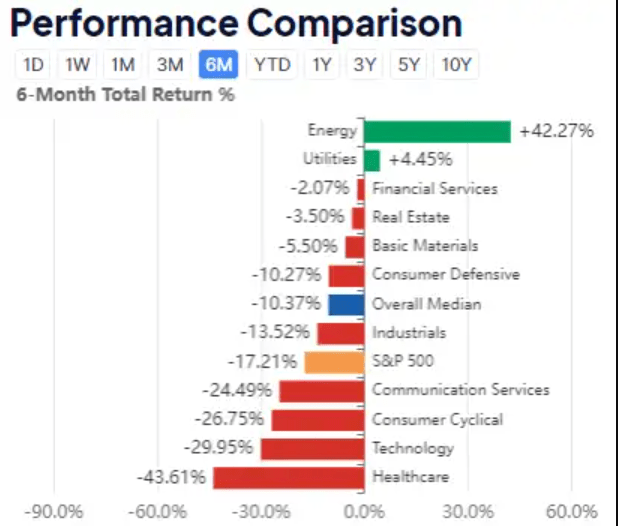
Sector performance in the last six months

It sucks buying individual stocks for the right reasons (profitability, free cash flow, revenue growth), yet the price goes down…… a lot.

As an investor, not much has gone right. The majority of investors have seen their portfolio kneecapped in 2022. You are probably in the red unless you invested in certain energy stocks or the energy sector. 

As a new investor, you may have concluded investing is a game of regulating and maintaining your emotions. You are right. For long-term investors, you have to remain optimistic about the economy. It’s easy to be pessimistic, but from a long horizon, the market has punished investors/non-investors who are overly bearish on the economy.

Market corrections and even recessions are regularly occurring events. Even asset bubbles are normal. Nobel laureate economist Robert Shiller, who is also predicting a recession, said:

One problem with the word bubble is that it creates a mental picture of an expanding soap bubble, which is destined to pop suddenly and irrevocably. But speculative bubbles are not so easily ended; indeed, they may deflate somewhat, as the story changes, and then reflate.

Speculative bubbles don’t just pop – they may deflate and reflate

Successful investing is mainly psychological:

The stock market is a game of psychology. In the long run, stocks generally going up doesn’t prevent many investors from panic selling. People, in general, are victims of the external environment around them. Since the sentiment is that the economy is going into recession, it makes sense to sell everything and avoid further losses, right?

  • Financial advisors generally advise against investing in individual stocks, yet financial news channels dedicate large segments of their reporting to individual stocks.
  • No matter how intelligent and well-informed people are, that doesn’t make them more patient, less greedy, or level-headed during times of panic.
  • Nearly every investor, even good ones, suffers from recency bias. It is incredible how much different the sentiment changed just one year ago!

The Milgram experiment showed that almost two-thirds of people would kill someone with electricity if an authority figure told them to do so. The Stanford Prison Experiment showed rather disturbing results. In a less extreme example, many people know how unhealthy it is to drink alcohol. A recent study revealed zero health benefits for young adults who drink alcohol.

If you understand the general rules of investing, anyone can be successful. Investing is not like basketball; if you want to be as good as Stephen Curry, you need particular abilities and talent. Investing is much more a game of chance and probabilities. Those that succeed are not the most intelligent people. Successful investors are those that understand the rules of the game. They have patience and impulse control.

I have said this before, and I will likely repeat this but investing is difficult mainly for the reasons above. I have read behavioral financial studies showing that stocks going down can cause you physical pain. Long-term investing is challenging because human psychology works against us. Being knowledgeable about the risks of alcohol doesn’t change how it makes you feel when you drink an alcoholic beverage. Knowing the ins and outs of a company and its financials may not prepare you for what you will feel when the stock price falls 50%.

Luck and happenstance play a significant role in investing:

No matter how smart you are. No matter how much research you do, chance plays a big factor in investing. Whether you invest in single stocks or indexes, your portfolio performance is based on many external events beyond your control.

  • Apple nearly went bankrupt in 1997. They were 90 days from bankruptcy until Microsoft made a $150 investment in Apple. Since 1997, the stock has appreciated over 90,000%
  • Yahoo turned down $1 million to buy Google in 1998. In 2002 Yahoo turned down $5 billion to buy Google. Yahoo only wanted to pay $3 billion.
  • Yahoo offered to buy Facebook for $1 billion, which Mark Zuckerberg declined.

We can play the “What If” game forever; however, even the best investors cannot deny that luck plays a major factor in their success.

Why I invest in individual stocks:

Many financial advisors advise against investing in individual stocks. They say investing in a few stocks is riskier than an index or mutual fund that tracks the stock market.

Being a former financial advisor myself, I can tell from experience that most financial advisors err on protecting your wealth rather than growing your wealth.

There is fundamentally nothing wrong with investing in index or mutual funds, however;

  • You are guaranteed average/mediocre gains. There are no outsized gains.
  • Passive index investing is essentially dumb money or investing on autopilot. There is no analysis of the fundamentals or valuations of companies.
  • Safety in this type of investing is a myth. The S&P is down over 20%. The Nasdaq is down over 30% this year. There is no guarantee the indexes will rebound.
  • Meta, Amazon. Apple, Netflix, and Alphabet make up about 19% of the S&P 500. Investing in an index that mirrors or follows the S&P is heavily weighted in just five companies.

My point is the majority of passive funds are overcrowded with money flowing toward the same stocks. It is dumb money. Although there is some safety in following the herd, and easier to mentally digest for the average investor, it locks you into mediocre returns.

Do not just look at numbers:

The art of investing comes from the idea that you have to value things that do not yet exist. The irony is that it is impossible to predict the future, but successful investors must make educated guesses. I try to ignore predicting stock prices but predict emerging social trends or technological advancements.

That’s why it is important to invest in “garbage” companies. To overperform the overall market, you have to take actual risks and speculate. The stock market is fluid; there are no guarantees that current stalwarts or trends will stay the same in the next decade.

When you look at the stocks most widely held by ETFs like Apple or Microsoft, they already returned outsized gains and are most likely overvalued. There is a prominent place for these types of stocks in your portfolio as you can look at them like a ballast; however, owning just these companies is not enough to be a solid investor.

  • Bellwether companies can decline and fall.
  • Garbage companies can emerge and become the next Tesla or Apple.
  • Since they are unprofitable, they can be oversold and undervalued.
  • Outsized gains are created while holding unprofitable companies transforming into profitable companies.
  • All it takes is a few winners to offset the losses of stocks that underperform a diversified index.

Soley looking at numbers or accounting metrics to value a stock is silly. It would be like a baseball scout evaluating players based on statistics and not watching games in person. Imagine dating people solely based on their net worth, credit score, or income. A considerable amount of subjective analysis is involved in life, including evaluating the value of companies.

Importance of being an optimist in the long-term:

“There is no sadder sight than a young pessimist.” – Mark Twain

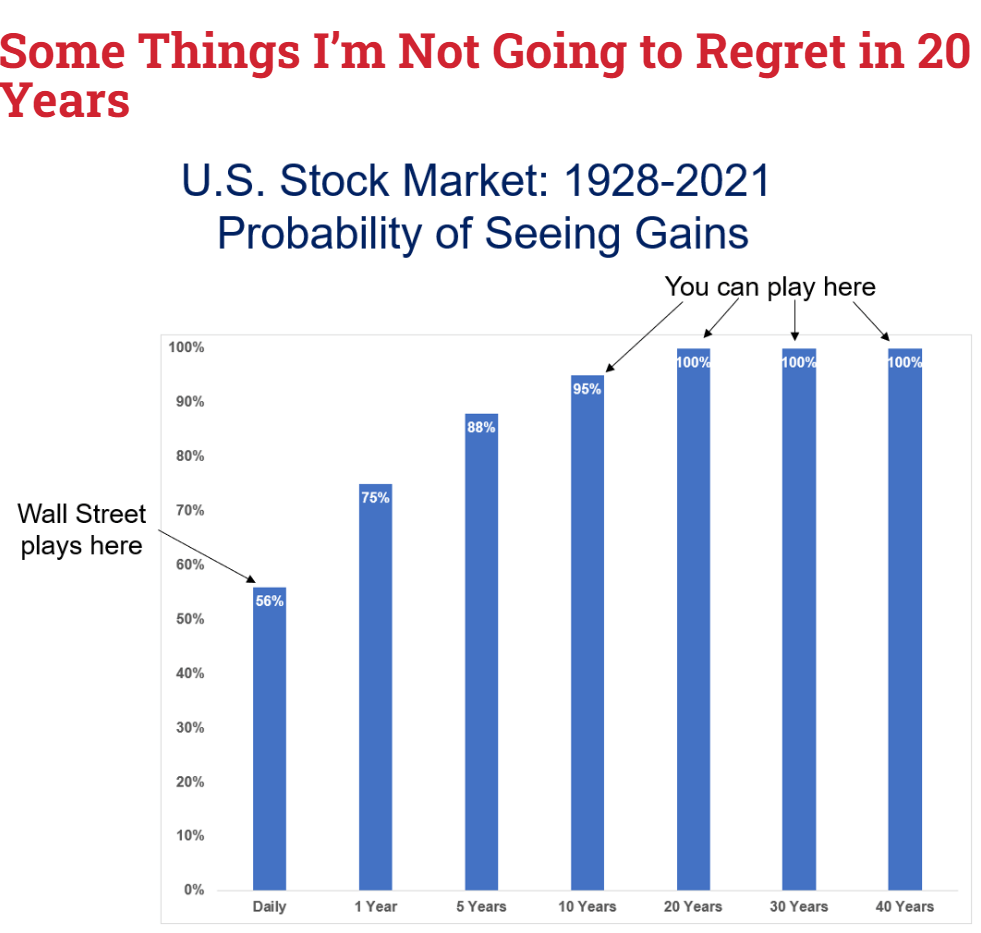
If you hear someone say the stock market will not produce any meaningful gains in the next decade or we will enter a global recession, remember the odds are not in their favor.

I cannot guarantee that the stock market will go up in the long term but based on history, it is a strong probability.

In our society, optimistic views have been considered naive or doe-eyed. Pessimistic views have been viewed as intelligent or enlightening.

Famous psychologist Rollo May wrote in his book Love and Will that “depression is the inability to construct a future.” If you are sad or panicked due to what is happening with the financial markets, it would probably make you more likely to have trouble seeing what the world will look like in 2026 or 2027. The key is sticking with a plan and not deviating from it.

Anytime in our history during times of despair or destruction, it has created opportunities for a rebound and urgent problem-solving.

Many people are poor at saving money and spend on frivolous things:

From CNBC: Of those earning $250,000 or more, 30% live paycheck to paycheck.

From The New York Times: A recent study by Fidelity Investments found that 45 percent of people aged 18 to 35 “don’t see a point in saving until things return to normal.” In that same age group, 55 percent said they have put retirement planning on hold.
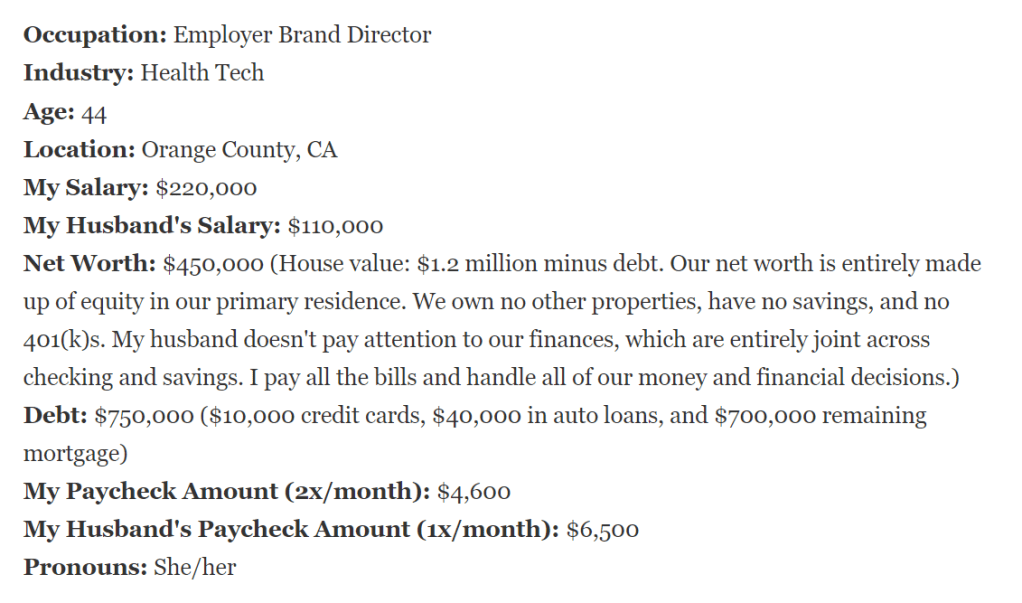
Insane story of how much an affluent wife spends in a week.

If you are living paycheck to paycheck on a 250k salary or spending $3,000 a week on single bagel app deliveries, you shouldn’t be thinking about investing.

Famous American feminist Gloria Steinem said, “the first problem for all of us, men and women, is not to learn, but to unlearn.” Consistently overspending is a recipe for disaster. Getting on a budget will require people to unlearn years or even a lifetime of bad habits.

I am investing. Many disagree with me; however, investing seems prudent vs. buying a car above its MSRP price or going on an overpriced vacation that will likely be more stressful due to global labor shortages.

Closing thoughts: Have a plan and stay optimistic.

Long-term investors,

Day Traders,

Professional Poker Players,

Sure it seems we speak different languages; however, whatever category you fit in, if you want to be successful, you need a plan and stick with it.

Most importantly, the best investing advice I can provide is to STAY OPTIMISTIC.

There is no evidence to suggest that our economy or humanity has peaked. It may seem naive to be optimistic, but it will pay off in the long run. Today is the best time to be alive in the history of humanity.

“Humanity can address a lot of the suffering that occurs in the world and make things a lot better. I think a lot of times people are quite sort of negative about the present and about the future, but really if you are a student of history, when else would you really want to be alive?” – Elon Musk

“The world is getting better, even if it doesn’t always feel that way.” – Bill Gates

“I’ll repeat what I’ve both said in the past and expect to say in future years: Babies born in America today are the luckiest crop in history.” – Warren Buffett

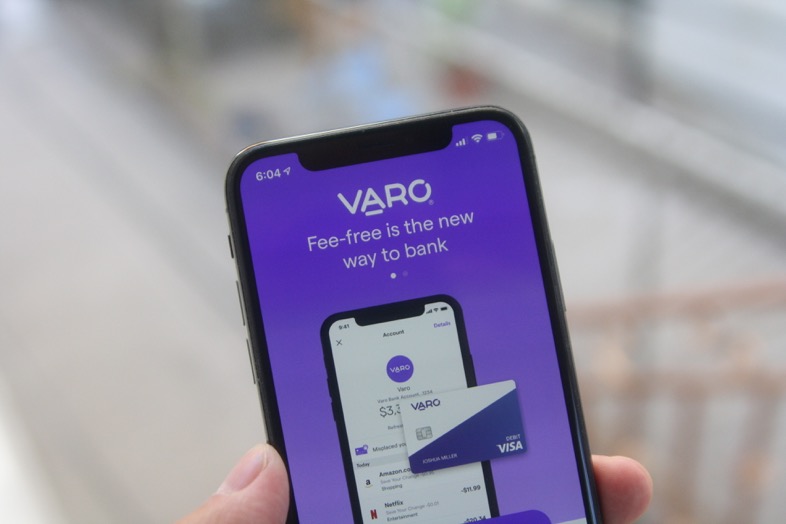
Hacking Bank Bonuses During A Recession

One of the best ways to earn free money is to sign up for bank bonuses. They are relatively easy to get and require minimal time. Usually, you need to move money around from a different bank, set up a direct deposit, or make a few debit purchases.

Some of the bigger banks require a deposit of $10,000+ in new money to get a $100 bonus. I have seen direct deposit requirements of $5,000 or more monthly! Here are three fintech banks offering sign-up bonuses that are easy to obtain, requiring just a few tasks. All of these banks have:

  •  No monthly fees or minimum balance requirements! You can have $1 in your account and not be charged a pesky maintenance or service fee.
  • Easily transfer money in/out to a different bank.

I found three fintech banks offering easy-to-obtain sign-up bonuses, which can help during times of high inflation and a possible looming recession.

Spiral:

Earn $50 HERE

  • Get $50 when you open a qualifying checking account, deposit at least $200 in the first 30 days, and maintain an account for at least 90 days.
  • Bonus will be paid into your Checking account within 30 days of meeting the criteria.
  • When you deposit money in your checking account, 0.25% will be moved to a separate account that will be donated to a charity of your choice. Remember, 0.25%, not 25%.
  • There is a $7 inactivity fee if you do not have any activity in your account for 90 days.
  • The Spiral app is only available on iOS; however, you can sign-up for an account on your computer.

Verdict:

There is no direct deposit requirement, and you can transfer $200 to your account for an easy $50. The charity/social good aspect is not a big issue, and it’s only 0.25%. The inactivity fee is annoying. You can just transfer $1 in your account every three months to avoid this, but with so many other fintech banks not charging such a fee, I will likely cancel my account after a year. Spiral offers a solid bank bonus for those who do not want to go through a dd requirement.

Varo

Earn $50 HERE

  • Spend $20 within 30 days of opening your Varo account. You will need to wait until you receive the physical debit card.
  • The bonus posts quickly, about 4-7 business days after meeting the spending requirement.

Verdict:

That is it. There is not much else to explain. The hardest part about this bonus is waiting for the debit card in the mail. Varo is an excellent beginner bank, and its interface is easy to navigate. I will hold onto this bank, and in the future, perhaps they will offer a direct deposit bonus.

Albert

Earn $500 HERE

*The $500 bonus has been reduced to $150. I would suggest anyone looking into this to wait for the bonus to increase. Albert reminds me of Cash App, they have a lot of generous cash back offers, such as 20% off at Whole Foods and 15% off at Etsy.

⓵ Sign up as a new Albert Cash member
⓶ Set up direct deposit with Albert Cash
⓷ After Cash signup, receive a qualifying deposit of $200 or more every 30 days for 90 consecutive days
⓸ Use your Cash card to spend $100 or more on goods or services every 30 days during the same 90-day period

Verdict:

This bonus will take a little more work; however, for $500, it’s well worth it. Typically, receiving $500 from a bank requires a deposit of $1,00,000+ or monthly deposits of $5,000+. I would snatch up this bonus asap as it will likely downgrade to $250 or $150.

When you sign up for Albert Cash, you will have to subscribe to their monthly subscription, Albert Genius, and the minimum amount is $6 a month. The bad news is I couldn’t find a way to bypass the Albert Genius screen. The good news is you can cancel or deactivate Albert Genius immediately after signing up. The first month is free, so there is no charge anyway. Per an e-mail I received from Albert Support, activating a Genius subscription is unnecessary to get the bonus. There is also an auto-saving feature that you can pause.

The great thing about these banks is that they all have referral programs that allow you to refer others using your own link. You can refer your spouse or partner, potentially earning both of you another sweet bonus. You can double or even triple the amount you can earn from bank bonuses.

For a few minutes of work consisting of transferring money, spending on bills you already pay for and linking your account through a direct deposit, you can easily earn $1,000 or more per year. $1,000+ isn’t life-changing money, but if you are one of many that complain they do not have any money to invest, here is a possible new stream of income.

If you have any questions or concerns about bank account bonuses, please let me know!

What Excites Me About Lemonade

It is one of the more exciting times to be an investor. Prices have been slashed, but the underlying thesis for many of these companies remains the same. Speculative companies with massive growth potential are still…. speculative; however, the downside risk has dissipated significantly. If these companies can still maintain their growth rates or have healthy cash balances, the risk of losing money on these investments in the long term has fallen dramatically.

Lemonade is a company whose stock has been obliterated in this market; however, the thesis remains the same:

  • Become the preeminent insurance company in the 21st century.
  • Create a digital insurance company with a different business model from traditional insurers. This model is powered by AI, telematics, and behavioral economics.
  • Turn insurance into a social good in society vs. a necessary evil. Completely change how people buy and manage insurance.

Key Metric to determine if Lemonade will succeed:

Customer Growth and Retention:

There are four key advantages traditional insurance companies have over Lemonade:

  1. More customers: This will lead to stabilized loss ratios. They have clients spread through all 50 states, which minimizes their risk from black swan events.
  2. Monopoly on good customers: The customers they have are older and wealthier. They are not likely to swap insurance companies due to their loyalty.
  3. Established brand name
  4. Stable cash balance

There is nothing Lemonade can do in the short-term about 2-4. However, Lemonade has quickly been able to find new clients. The problem is that rental and pet insurance are niche markets. Most of Lemonade’s clients are first-time insurers and are not considered profitable. The good news is these clients will eventually become profitable, which will lead to lower churn rates. Again, they won’t be able to poach away customers from legacy insurers. Those are loyal customers that won’t leave anytime soon. Lemonade MUST keep bringing in new millennials and Gen Z who care less about the status quo and enjoy Lemonade’s simple user interface, transparency, and social good aspect.

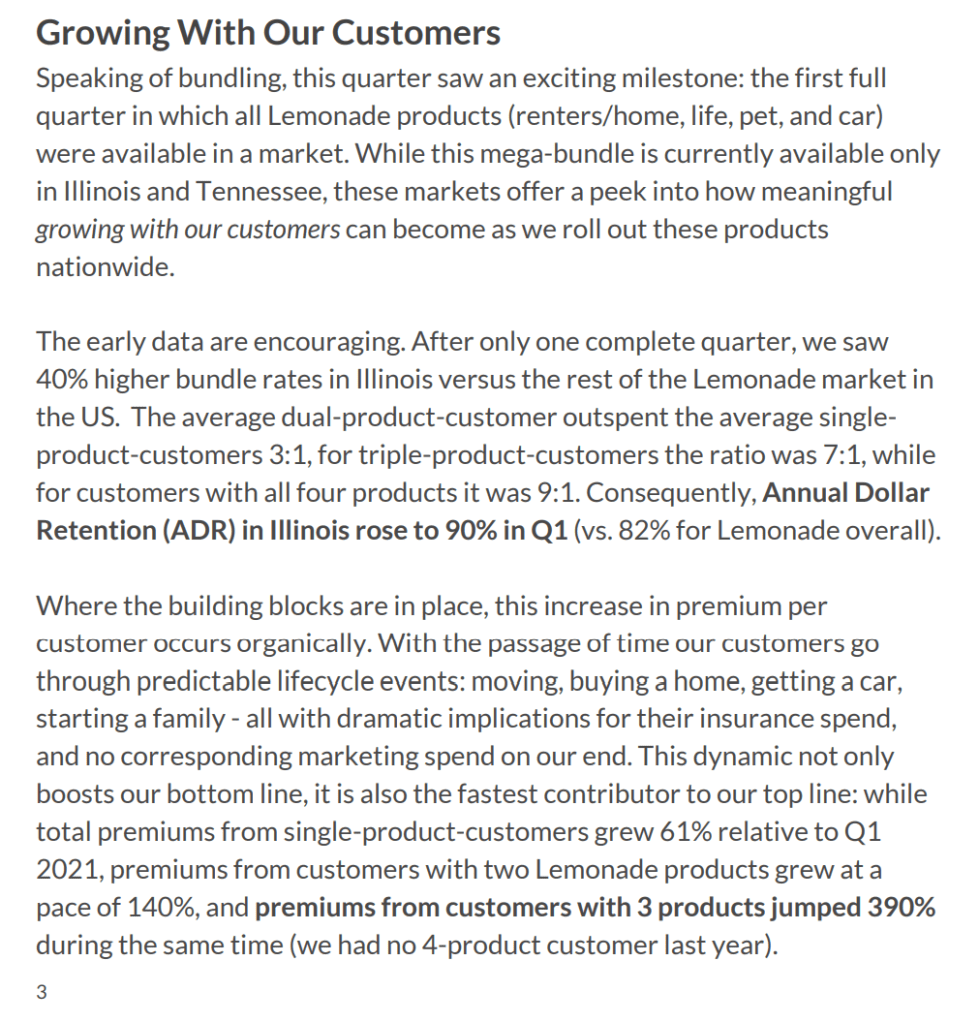
What is REALLY exciting about Lemonade’s future growth is the data from Illinois:

Q1 2022

I believe Lemonade car will be their flagship product. You have pets, renters, homeowners, life, and car as an amalgamation. Each product is valuable; however, when you bundle them all together, they have a symbiotic relationship, which allows for cross-selling.

It does not take much brainpower to realize that if Lemonade can offer its full suite of products nationwide, you will see higher bundle rates and lower churn rates as we saw in Illinois.

Imagine if you couldn’t subscribe to Netflix if you lived in California, Texas, Florida, and Texas? Evaluating Lemonade when car insurance isn’t available yet in states with the most licensed drivers creates an incomplete picture. The Metromile acquisition won’t be completed until Q2 of 2022, so we could see a rapid number of new markets in this year’s back half.

I view three critical metrics for an insurance company to succeed:

  • Continuously add new customers
  • Retain current customers
  • Underwriting.

I firmly believe that Lemonade will continue adding customers at a healthy growth rate as they have done from inception. I am confident they can retain these customers as they are popular and highly rated. They will address their churn rate by becoming a one-stop-shop for insurance. What Square is to banking, I could see Lemonade becoming to the insurance industry.

The growth is essential because for Lemonade to become profitable, they need to achieve the law of large numbers and have economies of scale. The more customers they have, the more intelligent and efficient their AI/Machine becomes in evaluating risk and underwriting. Customer growth is, thus, mandatory for the company to stabilize.

The unknowable factor is if Lemonade can effectively improve its underwriting and implement AI effectively. They have better technology. They collect 100x more data points per customer. The question is if they can use that data and technology effectively to create a profitable business. Unfortunately, we won’t find this out until they have more customers. They are also an early-stage growth company which means they have yet to reach economies of scale, and its goals are targeted toward the future, not current growth. I have confidence in their leadership and decision-making; however, taking insurance from scratch to compete with giants like State Farm will take several years to unfold.

The underwriting process is the most significant question mark for Lemonade and all other neo insurers. Here is an excerpt to explain how complicated underwriting is:

The practice of underwriting insurance is a fine mixture of art and science. To be successful, it takes a lot of common sense, even more experience and a well-rounded team of experts. Time and practice are the true keys to the profitable underwriting of life, health and disability insurances. As you can probably imagine, factors such as age, gender, occupation risk, financial viability and adverse health history play significant indicators in the underwriting of most insurance. But other, lesser obvious factors come into play when working in the specialty-risk side of the life and health marketplace.

The Nuances of Specialty-Risk Underwriting

During a Tesla earnings call back in October 2020, Musk said insurance someday could represent 30% to 40% of Tesla’s auto business. He boasted that Tesla is building “a major insurance company.”

The industry is ripe for massive disruption. It is inefficient and outdated, but entrenched companies are massively profitable. Companies like Lemonade, Root Insurance, and Hippo Insurance have slowly chipped away on legacy insurance. If you are still skeptical about this insurance revolution, consider what Elon Musk just recently said:

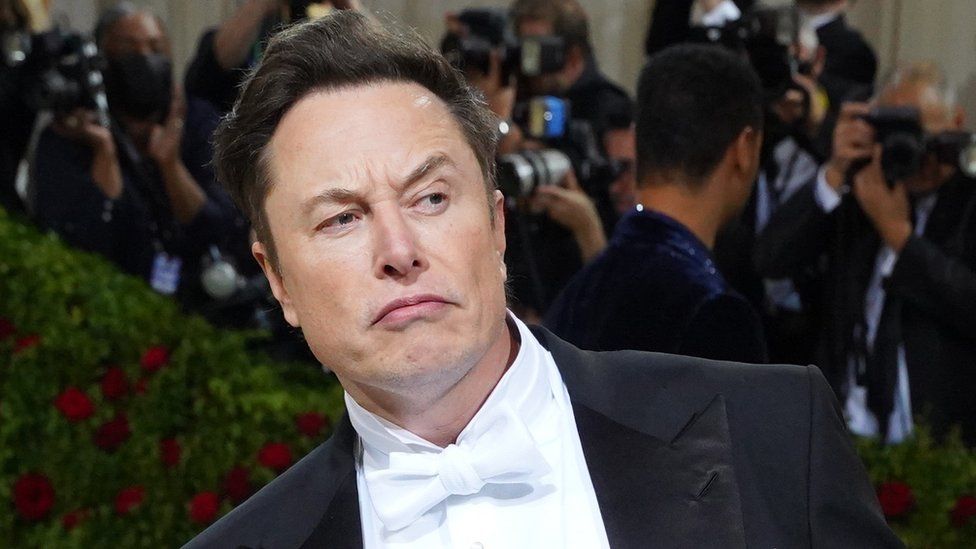
“The car insurance industry is incredibly inefficient,” Musk told attendees of the All-In Summit in Miami, which he joined virtually for almost 90 minutes. “You’ve got so many middle entities, from insurance agents all the way to the final reinsurer, there’s like a half-dozen companies each taking a cut.”

Tesla Bets It Can Bring Down Insurance Costs, Make Driving Safer

Tesla underwrites its own policies. They are entering auto insurance more aggressively. Will they succeed? I am not sure. The more this industry is disrupted, the better chance companies like Lemonade can take massive market share away from legacy insurers. If Telsa does become a major insurance company, they are only in one market dealing with Tesla vehicles. Lemonade has the entire insurance market.

I look at Lemonade like a small fire. Once it spreads, it can do so rapidly at an uncontrollable rate. Lemonade’s operating team runs in a very autonomous and frictionless way, which is why they have had success in an industry that typically moves at the speed of molasse. It’s like their version of “Move fast and break things.” I look at them more like a tech company than an insurance company.

From an operational standpoint, Lemonade moves from how to get from point A to D while others companies are moving from point A to B. This kind of thinking makes them misunderstood, and if you do not like volatility, you shouldn’t invest in Lemonade. If you can stomach the roller coaster over the next few years, Lemonade could be a big-time winner in this space.

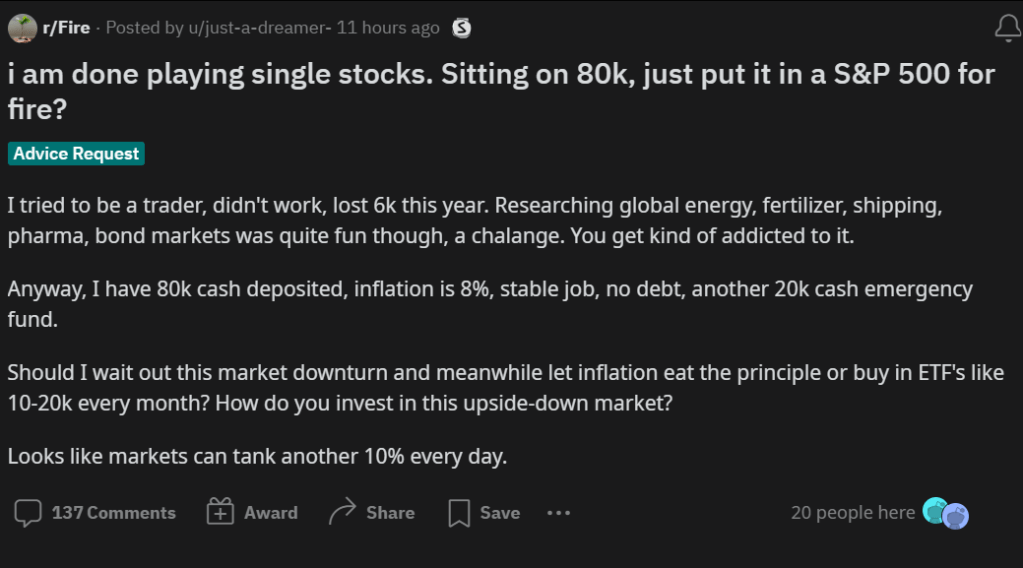
Reddit React: I am Done Playing Single Stocks

After reading this Reddit post, I thought of one of the best Warren Buffett quotes: “If you aren’t willing to own a stock for ten years, don’t even think about owning it for ten minutes.”
If you are “playing” stocks, you are gambling, not investing. Go to a casino or bet on your sports if you want to gamble. People can gamble with stocks, but you need an actual specialized strategy and skillset to succeed.

Most people do not know where the market is going in the short term. Most long-term investors say it is not even possible to make these predictions. There is more safety in buying ETFs; however, ETFs, Indexes, and Mutal Funds most likely tank along with individual stocks in a recession or a sharp downward market.

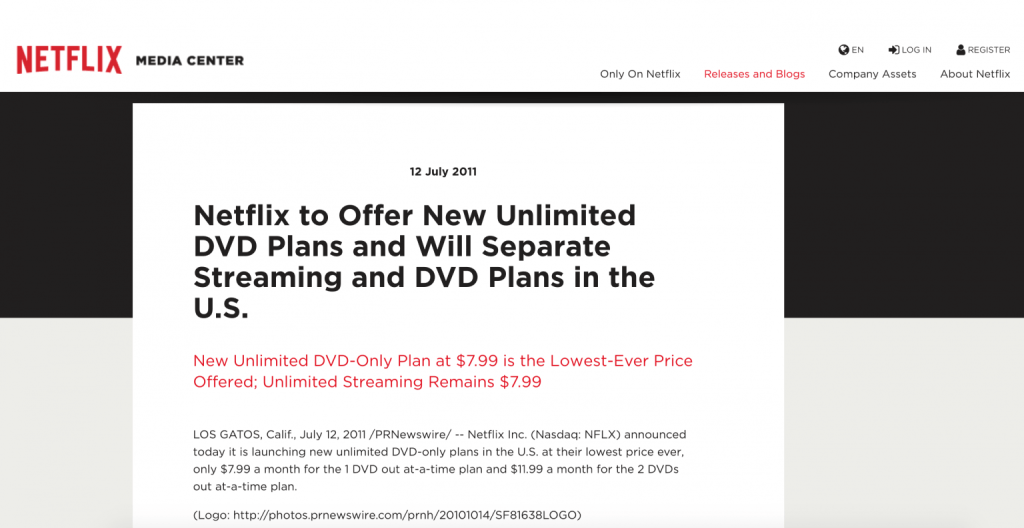
An investor’s best friend is time. I remember an investor telling me a story about buying stock in Netflix in 2011. The stock price cratered by 80% because they hiked the cost of their service by more than 60%.

If you had bought Netflix stock at the high of 2011 and saw your shares crash 70-80%, you would still be up by 300-400% today! If the stock price can recover, you are likely back up over 1,000%, as you were in 2021.

Watching a stock you sold soar x1,000% in price is a terrible feeling. Imagine if you bought into Netflix and believed in their streaming service plans back in 2011….. but due to fear, you completely sold out and missed out on all those gains. That is the worst type of pain you can experience. Even worse than watching a stock price fall to rock bottom. Imagine how the co-founder of Apple felt who quit and sold his 10% of Apple back to Steve Wozniak and Steve Jobs for $800 in 1976.

If you are playing with stocks do not forget these are real businesses run by real people. By owning just one share, you are a shareholder of the company. Most games you play produce binary events, winner or loser. Business is quite a bit more multifaceted. There could be several winners or several losers. Some companies can lag for decades and eventually become grossly profitable.

Always remember time is the most powerful force in investing. It makes little things grow big and big mistakes fade away.

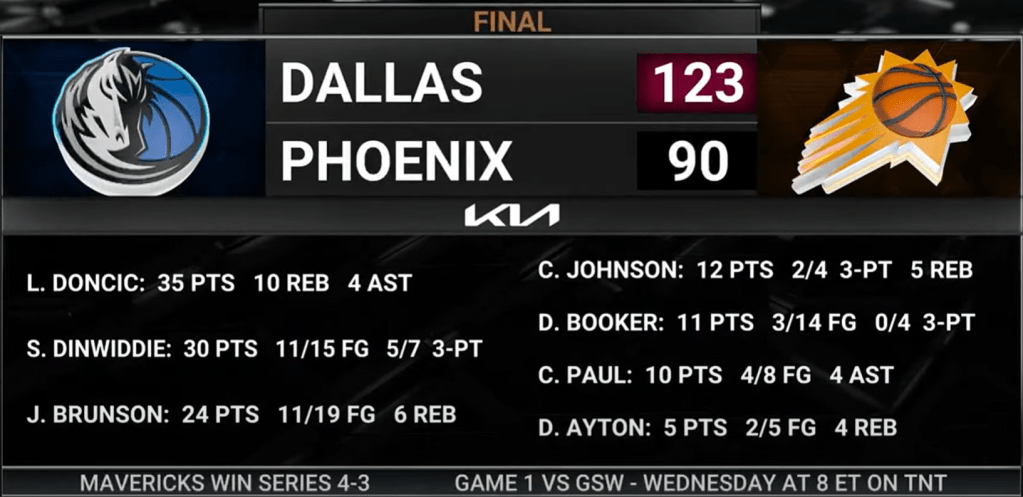
Experts Are Always Right…….

Phoenix Suns (1) vs. Dallas Mavericks (4)

Jerry Bembry: Suns in 6

Kendra Andrews: Suns in 6

Jamal Collier: Suns in 7

Nick DePaula: Suns in 6

Nick Friedell: Suns in 6

Kirk Goldsberry: Suns in 6

Israel Gutierrez: Suns in 6

Tim Legler: Suns in 6

Andrew Lopez: Suns in 6

Zach Lowe: Suns in 6

Tim MacMahon: Suns in 7

Bobby Marks: Suns in 6

Dave McMenamin: Suns in 5

Kevin Pelton: Suns in 7

Omar Raja: Suns in 6

Jorge Sedano: Suns in 6

Ramona Shelburne: Suns in 7

André Snellings: Suns in 5

Marc J. Spears: Suns in 6

Ohm Youngmisuk: Suns in 7

Why Elon Musk Is Right About Investing

“The greatest shortcoming of the human race is our inability to understand the exponential function.”

― Physicist Albert Bartlett

Elon Musk recently tweeted a brilliant yet straightforward investing strategy that can make you wealthy. “Since I’ve been asked a lot: Buy stock in several companies that make products & services that you believe in. Only sell if you think their products and services are trending worse. Don’t panic when the market does.”

Simple yet powerful.

Most of the supposed long-term investors are gone during this sharp market sell-off.

Growth stocks or high beta volatile companies have gotten out of favor with the “experts,” fund managers, and retail investors. Just tune in to CNBC and hear how the market will continue to go lower and high-flying stocks like Shopify and Nvidia have no bottom. Ironically, just six months ago, the same people said these were must-own stocks in an investor’s portfolio. Everything is selling off despite the quality of earnings.

Stocks go up. People say buy, and you buy;
Stocks go down. People say sell, and you sell.

Welcome to Wall Street.

Listening to the herd will lead to mediocre results. Macroeconomic headwinds have become more important than fundamental metrics, and everyone should mostly be in cash or defensive positions. Haven’t you heard? High-growth tech stocks are uninvestable for the next six years!

Although Musk offers solid value-investing advice, few people can follow it. That is because humans are, by nature, poor investors.

Why do so many people sell all their holdings during steep market drops and move into bonds, gold, and cash?

It’s easy to be a long-term investor during a bull run. It’s easy to buy and hold stocks when everything is going up.

There is only one reason to buy a stock. There are several reasons why someone sells. Fear drives most selling decisions, especially during this market downturn. Humans are good at surviving, so the justification for selling stocks when they are down big would be like our brain telling us to take our hand off the stove.

“Life is a comedy to those who think, a tragedy to those who feel.” – Jean Racine

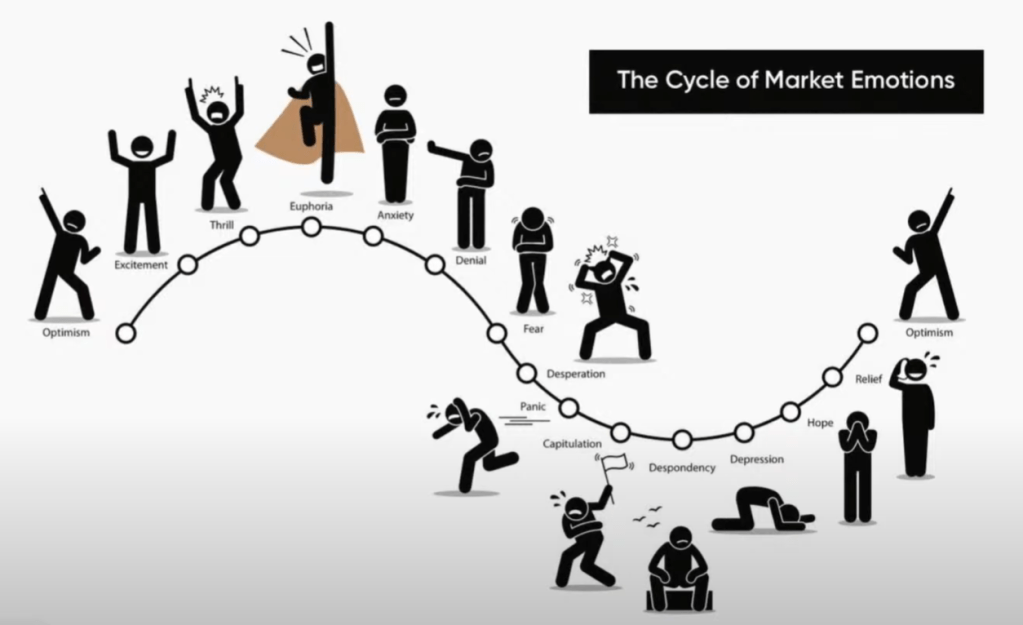
There is a cognitive dissonance that investors deal with daily. When the market goes up, people often experience euphoria. Emotions can come into play, and we become seduced by market gains. During euphoria, everything works. If stocks keep going up 5% every day, they must be doing well, and people start justifying buying stocks at ridiculously high evaluations. When the script flips and the market goes down, fear creeps in. We become obsessed with falling prices and sell stocks of companies that are fundamentally intact as a way to end the pain we are feeling. This fear can lead us to sell stocks at ridiculously low evaluations.

These cycles of market emotions are why it is crucial to have a level head if you are a long-term investor. I try to always stay in the optimistic stage of market cycles. Not too despondent to avoid all risk and not too euphoric and disregard valuation.

Think of investing as trying to maintain homeostasis. Homeostasis, from the Greek words for “same” and “steady,” refers to any process that living things use to actively maintain fairly stable conditions necessary for survival. In our everyday life, we often make the best decisions in homeostasis. Think of a time when you have gotten little sleep, didn’t eat anything for a prolonged period, or were sick. That’s not the best state to be making important life decisions.

There is constant chatter and noise from the market that moves us away from homeostasis for a prolonged amount of time. Times like these allow investors to start making irrational decisions based on emotion instead of sound logic.

People may fear selling their entire portfolio because they don’t want to see it go to zero. That’s irrational and highly unlikely. Ask someone who fears flying why they drive to work every day when the risk of getting in an automobile crash is significantly higher than being in a plane crash.

No matter how much sense it makes to fly, we wouldn’t want someone with an intense fear or phobia of flying to get on a plane because it makes more logistic sense. It could put someone in an uncontrollable downward spiral. Investing is the same way. If you cannot manage your anxiety, you should consider not investing. Long-term investing requires you to feel uncomfortable. The emotional aspect of investing is just as important, if not more than the technical aspect. In times like this, thinking critically, building conviction, and ignoring the herd mentality are necessary, making you vulnerable. We start seeing who has the temperament and those that sell out and leave the market altogether.

Regarding technology stocks like Amazon and Shopify, yes, consumer behavior is returning to where it was in 2019. Recently we have seen e-commerce slow down, but this isn’t a secular decline. It may seem like that, but I would chalk that up to significant pent-up demand for going outside due to the pandemic. Growth is going back to the trend line before the pandemic, but not below it. Do not mistake this as a secular trend as a peak for e-commerce and a significant comeback for physical stores. I question any analyst who thinks there will be a long-term decline in people shopping online, playing video games, or streaming. These activities trended upwards before the pandemic and will continue to do so in 2023 and beyond.

Today stocks are cheaper and more reasonably valued. Many of these companies are fundamentally okay, in much better shape than 2-3 years ago. Tesla and Apple reported stellar earnings and met most analysts’ expectations. In this market, that doesn’t matter. Their stock prices fell massively.

Eventually, the mood will change, and fundamentals will matter again. Expectations and comps will be so low that companies will easily beat earning expectations, likely causing their stock prices to rebound.

My advice? Relax. Any long-term investor will go through dark times. Bad stuff happens if you are in the game for the long term. It is unavoidable. Like in life, you get sick, lose a job, get dumped, divorced, etc. Pain is a part of life. The great thing about investing is that the probability of you “winning” is very high with time as the greatest weapon against noise and sentiment. Ultimately the market will return to its homeostasis as it always does.

The last point I want to cover is that investing in single stocks is too risky compared to a broad-based, passively managed index fund. You have to look at it from a risk-reward tradeoff like all investing. When you invest in an index, you are striving for average results. It is investing on autopilot. To strive for certainty is to doom oneself to mediocrity. There is nothing wrong with mediocrity as that can still net you six or seven figures. The risk is low-medium, with the reward being medium-high. With single stocks, the risk is medium-high, with the reward being high-exponentially high. There are no outsized returns investing in a broad U.S stock index fund. Most ambitious people do not strive for just average results in school, life, professionally, personally, etc. Why is it acceptable to be an average investor, especially when exponential gains are possible? The two greatest weapons an investor has is time and temperament. If an investor of single stocks uses those two controllable weapons in their favor, the risk profile decreases significantly.

Morgan Housel is a partner at The Collaborative Fund, an expert on behavioral finance and history. He is a wealth of sage advice during times like this. Here are some of the best quotes I have found from his blog:

The world is governed by probability, but people think in black and white, right or wrong – did it happen or did it not? – because it’s easier.

If you said something will happen and it happens, you were right. If you said it will happen and it doesn’t, you’re wrong. That’s how people think, because it requires the least amount of effort.

Every investor is making a bet on the future. It’s only called speculation when you disagree with someone else’s bet or time horizon.

When there are no recessions, people get confident. When they get confident they take risks. When they take risks, you get recessions. When markets never crash, valuations go up. When valuations go up, markets are prone to crash. When there’s a crisis, people get motivated. When they get motivated they frantically solve problems. When they solve problems crises tend to end.

Good times plant the seeds of their destruction through complacency and leverage, and bad times plant the seeds of their turnaround through opportunity and panic-driven problem-solving.

One of the Navy SEALs from the Bin Laden raid wrote a book about his life in the military. Technical skills are important to be an effective soldier, he wrote, but “one of the key lessons learned early on in a SEAL’s career was the ability to be comfortable being uncomfortable.” Same in investing.

Collaborative Fund

Best of luck to anyone reading this. Just remember, you can sell your entire portfolio to avoid further losses. You aren’t guaranteed to participate in the recovery. You would have to time the market perfectly. A long-term investor is guaranteed to suffer through steep losses but is also guaranteed to reap the rewards of an eventual recovery. Some people do not believe a recovery is coming. Stocks are in the doghouse indefinitely. If you believe this, then yes, you should sell your portfolio. However, you are betting against America’s prosperity, which Warren Buffet has recommended not to do. Do you want to bet against America in the long term? That seems like a losing bet.

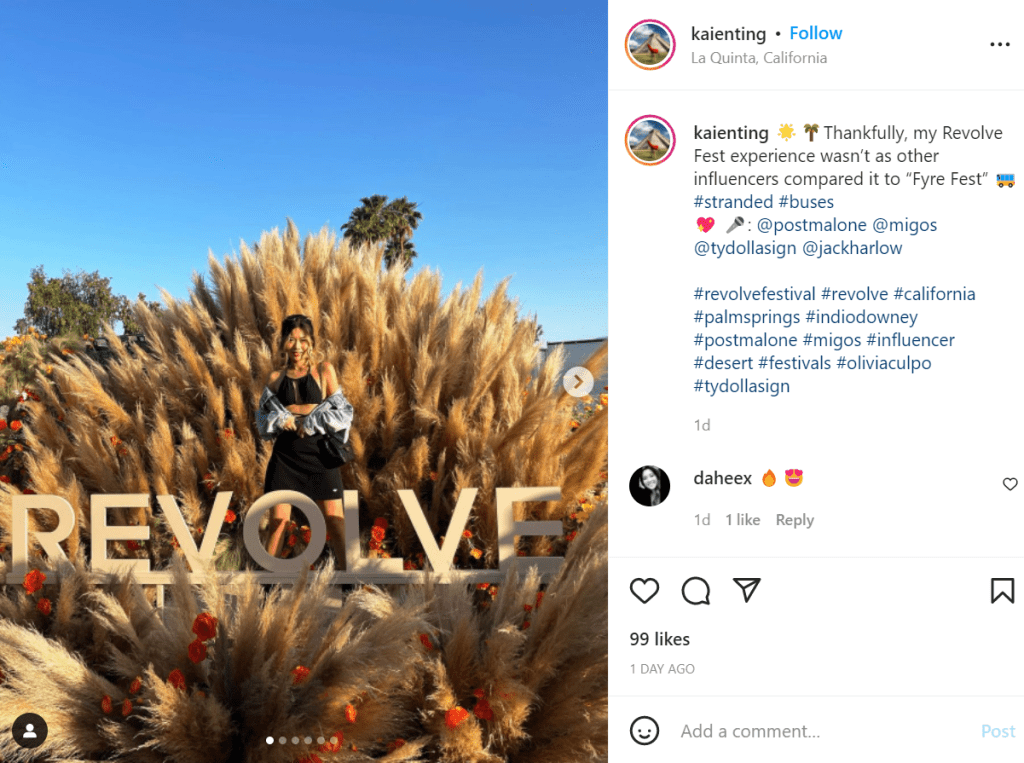
Revolve Festival Will Be Fine.

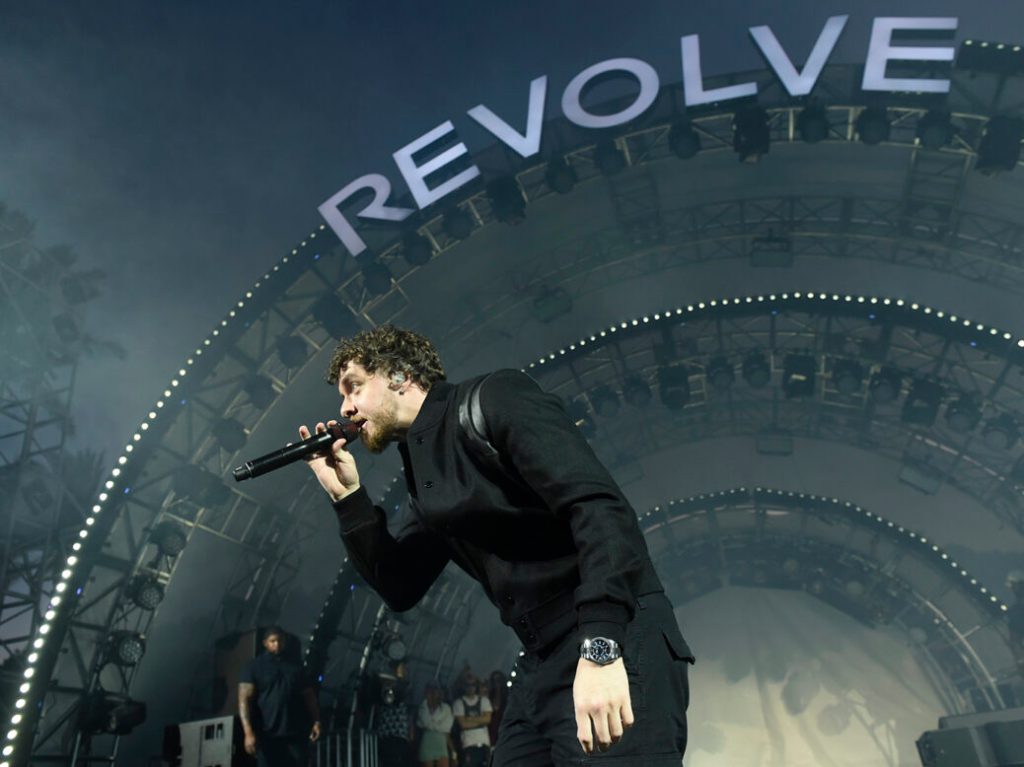
LA QUINTA, CALIFORNIA – APRIL 17: Jack Harlow performs onstage during the REVOLVE x The h.wood Group Present REVOLVE FESTIVAL at Merv Griffin Estate on April 17, 2022, in La Quinta, California. (Photo by Vivien Killilea/Getty Images for REVOLVE)

The media ran with the story of Revolve Festival being compared to Fyre Festival 2.0. In the short term, it does not help the company’s brand; however, the story has died down and has minimal impact on its intrinsic value.

I am an investor in Revolve. Group. I have never bought anything on their website and am nothing close to a social media influencer. I do not even have a Tiktok account. Revolve Festival’s negative attention ma worried me as an investor; however, the story is sensationalized as a non-story disguised as a major headline.

Frye Festival was a fraudulent festival. It was a con in the Bahamas where people spent between $1,000 and $12,000 on tickets for a fake event. The organizer of the event is now in prison.

The Revolve Festival is an actual invite-only event that was launched in 2015. People had to wait in long lines for shuttle buses and were stuck in the heat with no food or water. Those that attended the festival had a great time, but the negative criticism is mainly from those that waited and never got in.

I do not mean to point out the obvious, but any major event with high demand will see long wait times. The people that get preferential treatment are the super influencers and A-List Celebrities.

I am reminded of the song “That’s Life,” which Frank Sinatra made famous in 1966.

Revolve made a logistical error in inviting too many influencers for an exclusive invite-only event. They could have done better, but the headlines sound like a complete overreaction to what actually happened. Micro-influencers are complaining that they were treated like commoners.

Revolve group had profits of $99.8 million, up 76 percent from $56.8 million in 2020 and ahead of the $35.7 million seen in 2019. Sales of $891.4 million rose 54 percent from $580.6 million in 2020 and exceeded the $601 million total in 2019

Being a non-expert on this subject matter, I looked for experts’ opinions on the subject matter. From blogger Elise Purdon:

Revolve Fest has become one of the biggest and most important networking opportunities for influencers, especially smaller ones, every year, and many are dying to get in to advance their careers. Some of their reactions were likely driven by career anxiety of missing the festival and thus a huge opportunity, rather than being sweaty and bored. “The real problem is that Revolve has such a power over the industry that people are willing to fight and shove and stand all day in the desert to try and get on a bus to get into this thing where they aren’t even getting paid to create free advertising,” she said. (Many influencers receive store credit in exchange for posting about the invite-only event, according to reports).

Stephanie McNeal’s newsletter

Revolve Festival is the creme de la creme event for influencer marketing, explaining the crazy demand they get. The festival has become more prominent than the actual festival, Coachella. They get more likes and impressions than H&M, Coachella’s official partner. Revolve has been running circles around global brands that bring in billions every year. The influencers complaining are likely the same people that would pay $10,000 or more to attend this festival if they could be treated like Kim Kardashian or Kendall Jenner.

Revolve Festival is a signal of Revolve entering the slope of its growth S-Curve. Revolve is as much of a clothing company as Tesla is a car company. They have an army of social media influencers who will get bigger and stronger. The company is multiplying, and the overall sector is expanding as well. For an investor, that’s what you want to see.

I respect social media influencers because it takes tremendous talent and hard work to amass millions of followers. They are hungry entrepreneurs trying to build their careers. Influencers are the lifeblood of Revolve and are necessary for their future growth. I compare the importance of influencers similar to software engineers for companies like Google, Meta, Tencent, etc. Tech companies need talented software engineers to grow their companies. They get paid a lot because there is such a low supply of them on the job market. The best influencers actually make as much money as the best software engineers, which, you can argue, makes them more valuable.

The negative headlines will likely die down. Disgruntled engineers leave tech companies every day, so Revolve can’t please all their influencers. There is no call for a boycott or cancel Revolve Festival because this story is a non-story. This will do nothing to stop the demand for events like this. Revolve understands the value of influencers and provides them attractive compensation packages. They are one of the few companies that pay influencers like tech companies pay software engineers. Until companies like Macy’s and Nordstrom adopt this model, Revolve will continue to take their lunches as they have been doing for the past 5 years. The cost of paying influencers will be significantly higher in the future. Revolve is paying discounted rates for influencer marketing, leading to stellar revenue growth. By the time traditional retailers react and Revolve groups lose their moat, they could be a mega fashion conglomerate. The growth train has started, and it will be hard to stop.

Why Twitter Is No Meta

Elon Musk has offered $43 billion to buy Twitter, a platform on which he has over 80 million followers.

My initial thoughts: Twitter the application is still an important social networking platform for breaking news and communicating with people. As an investment? It is a dumpster fire.

Twitter was one of the first stocks I have ever bought. The stock price I bought was under $20. My reasoning was that it is still a great product, and management would eventually have a plan to fix its stagnating user growth and inconsistent revenue growth. Most importantly, Donald Trump becoming the 45th President of the United States would send the stock soaring. He would end up sending almost 24,000 tweets as President.

Despite the attention Trump gave Twitter, it did not solve its lagging user growth issue. I ended up selling my shares of Twitter for around $38-40 and concluded the company was not a good long-term investment anymore.

My hypothesis on successful social networking sites is that they have a 5-10 year runway of max popularity and user growth. Each generation wants its own space, as it seems naive to think that those in their 20s will hang out on the same app as those in their 30s, 40s, 50s, etc. The principles of managing a networking site are not much different than running a big social club or gathering place. As the event organizer, it is your job to get as many people to attend and monetize each attendee. There is a ton of competition, so the organizer needs to keep attracting new people.

Twitter missed its best opportunity to generate revenue and users from 2010 to 2020. Facebook became a powerhouse through the network effect, and Twitter failed to capitalize when its window was open. Things like Tip Jar, Super Follows, and Ticketed Spaces were good ideas when Snapchat and Tiktok were not even a thing, but the landscape today in social networking is more competitive and challenging.

From an investment standpoint, Twitter is the Ben Simmons of stocks. Stephen A Smith has stated, “Ben Simmons is a jump shot away from being the second coming of Lebron James.” No matter how talented and good a player Simmons is, there is no reason to guard him if he refuses or is afraid to shoot 3-pointers. A starting guard in the NBA should make at least 100-200 3-point attempts in an entire season. Simmons, in his career, has only attempted 34 3-pointers his entire career! Simmons is a talented people player but does not attempt outside shots even when unguarded. Twitter is an influential company that many people know about but is not widely profitable or used.

Twitter is a conundrum whose best days are behind them. It is a rudderless ship. Who exactly runs them? The new CEO does not even own 1% of Twitter shares. They continuously fail, and I see only three options left:

Elon Musk buys Twitter and takes them private.

Twitter employees do not want him, the Twitter board does not want him, and the government will do everything to nix this deal. Making Twitter a pro-free speech platform sounds good from a constitutional theoretical perspective, but in reality, it is something that scares politicians. When you ask Americans broad questions like if freedom of speech should be protected or if people can express unpopular opinions, you have a consensus. When you ask more specific questions, like should people express anti-COVID-19 information or if Neo-Nazis should be allowed to march in a town with a majority Jewish population, you start getting polarization and divergence.

Twitter gets bought out by another company.

Meta and Google are dealing with their own antitrust issues, so adding Twitter would be a headache. The Federal Trade Commission approving Meta or Google acquiring Twitter is more likely than Elon Musk buying them. Disney, PayPal, Microsoft, Salesforce, Netflix, and Oracle, could all be potential buyers. This would be the best-case scenario for a tech giant or white knight to come in and take over. However, I doubt any company would want to pay more than the $43 billion Musk offered.

Remain a public company.

Twitter keeps the status quo, with little insider ownership and lofty goals likely never met. Sure, there is a lot of upside potential, but the problems in 2016 are the same today.

“With no controlling shareholder and major activist investors as shareholders, if the company does not execute, Twitter’s days as an independent company are probably numbered.” Jonathan Boyar, managing director at Boyar Value Group, which owns more than 38,000 shares in the social media platform, with a rough valuation of $1.75 million.

Twitter itself is one giant ecosystem. Compared with Meta Platforms, a more extensive ecosystem with other ecosystems interconnected. You can argue that Facebook is more dated than Twitter, but Facebook is just one facet of Meta Platforms. Look at Facebook as the Capital of Meta. You have Instagram, Whatsapp, and Oculus VR. These are the cities that make up a giant state in Meta. Here is the entire list of companies that Meta has acquired. While Facebook has grown where it is now only one aspect of Meta, Twitter is just…… Twitter.

When I was a Twitter shareholder, I had an underlining suspicion that management was incompetent and void of leadership. Twitter could have been a tech giant, but the company has languished. It is an aging platform with medium growth potential. Under the proper guidance, it could be a nice add on to a parent company (think when Louis Vuitton acquired Tiffany); however, its value has significantly declined since its prime.

Meta is not the most innovative or coolest tech company anymore; however, they are the most influential. They have billions of people in their sphere with a war chest of data and cash at their disposal. The leadership team at Meta operates at extremely high efficiency, which will likely lead to them becoming more profitable and bigger.

In 2017 they copied Snapchat Stories with Facebook and Instagram Stories. Reels is a copy and paste of TikTok. Before Reels, Meta launched Lasso, the original TikTok clone. This is what behemoth tech companies like Meta do. Encourage people to use its apps with new features and see what they like and dislike. They will experiment with making the app better until they kill their competition.

This is why Meta is a superior investment compared to Twitter. They are already aggressively focused on the future and have a giant customer pool at their disposal. The evolution of how we communicate via technology has evolved from text, photos, video, and eventually, the Metaverse.

Meta has many failed projects that never worked out, but like in investing, their big winners overcompensate for their many losers. Whatever their version of the Metaverse is, it will likely be big and profitable. Knowing the stock price (NASDAQ: FB) is down nearly 50% from its peak. Knowing this is not a very friendly environment with rising interest rates and supply chain issues. I see Meta as still being massively undervalued. At the same time, Twitter is stuck in a ditch, waiting for someone to save them from years of mismanagement.

How To Cancel Student Loan Debt Responsibly

President Joe Biden extended the pause on student-loan payments for a fourth time, through August 31.

I disagree with this decision because it isn’t needed at this moment. The majority of student loan debt is held by the wealthy and upper class. These pandemic pauses are indirectly benefiting people that do not need relief.

Per Marc Goldwein of the Committee for a Responsible Federal Budget, doctors and lawyers are getting most of the relief, while those with only bachelor’s and associate degrees are receiving crumbs.

This is not a good idea and an even worse idea is to completely forgive all student loan debt. At this time canceling all student loans would likely increase inflation, and that’s the last thing we need right now.

From Bloomberg:

For the past two years, more than 40 million borrowers have been allowed to forgo making their monthly payments. The vast majority made no payments at all during the pandemic, even though the government set interest rates at zero. This has already cost about $120 billion in lost revenue; the latest extension will cost at least $17 billion more.

I do not believe canceling all student loan debt would spur the economy. For those debtors living paycheck-to-paycheck, it would provide minor short-term relief at best for a much larger issue.

For the high earners who were regularly making payments before the pandemic, I see less logic in forgiving debt for those that have the money and resources to pay it back.

The system needs to change and certain people do need relief with student loan repayment. One simple solution I propose is allowing $1,200 of your student loans to be completely forgiven if you can volunteer 40 hours, which must be completed within 6 months.

The current estimated national value of each volunteer hour Is $28.54. 40 hours x 28.54 is 1,141.6 and you can round that up to 1,200.

My reasoning:

  • Provides enough financial incentives and schedule flexibility for high earners and working professionals.
  • Create a demand for volunteer work instead of the debtor getting a part-time job or delaying paying their student loans altogether.
  • Something digestible that could be approved by Republicans and Democrats.
  • Doesn’t take away from other forgiveness programs.
  • Less rigid than government-supported programs like AmeriCorps and the Peace Corps.
  • Attracts a diverse group of people into a variety of volunteer opportunities.

This is a simple one-time solution that creates immediate economic value and helps with the ongoing labor shortage. It can include more service-oriented volunteer work such as picking up trash or helping at a food bank. It also would be expanded to more freelance-type work like social media consulting, legal aid, tech support, etc. For the doctor or lawyer, this seems like a great opportunity to provide consultation work to residents of a retirement home or help Ukrainian refugees start the asylum process.

If this pilot program received high demand and had proven results, increasing production output in the economy, you can increase the number of hours you could volunteer to forgive your student loans. Overall, I see this as a major win for everyone involved. The number of quality hours produced through this program would outweigh the loss of revenue through canceling $1,200 in student loans.

Simple Steps To Find A Great Stock

What criteria do I use when picking the stocks I invest in? I try to keep it super simple. Some investors use complicated formulas and algorithms. I can tell you from experience that isn’t necessary. Being a great investor doesn’t require a high IQ. What great investors tend to share is a strong ability to think and to remain calm under pressure. There are simple steps a long-term investor needs to do to find a truly great stock that does not involve a ton of work or to analyze elaborate valuation methods.

Vision to see them

Courage to buy them

Patience in holding them

So how do you spot a great stock?

4 basic questions an investor must ask themselves:

Can the company do well, or even thrive during a black swan event? Think of buying a house. Would you buy a home that couldn’t withstand a storm or heavy winds? There is a reason why I do not have much invested in airlines or banks. Great companies not only survive but they can prosper during the most uncertain times.

Is there high insider ownership? This is pretty straightforward. Typically high insider ownership signals confidence, but it is kind of expected for the CEO or management to own a lot of the company stock. High insider ownership alone should not be a reason to buy a stock. Some of the best companies are founder-led, and typically have a symbiotic relationship with the company. They try to do the best thing for shareholders, even if that means devaluing their compensation or well-being.

Take the example, of the NFL. Kirk Cousins is one of the top-ten highest-paid quarterbacks in the NFL, and his salary makes up about 16.61% of his team’s cap space in 2023. The problem is there are 52 other roster spots on a team, and the Minnesota Vikings did not even make the playoffs last year. Compare that to Tom Brady, whose salary is about 10.96% of his team’s cap space. You cannot blame Cousins for accepting such a ridiculous contract however, he did his team no favors as his massive salary enriches himself personally but cripples the team’s salary cap.

Is the company financially stable? Key factors include cash available, debt, and free cash flows. Typically the more profitable the company, the more likely it would survive during a recession. There is nothing wrong with investing in a company that isn’t profitable or has weak financials, however, the risk level is much higher. Financially weak companies most likely cannot acquire other businesses or buy back their shares.

Does it have a moat? A moat is a durable competitive advantage. It is a barrier that keeps competitors from breaking through. A few key points about a moat:

  • Most companies do not have a moat.
  • Moats are sometimes not easily identifiable and are not permanent.
  • Some industries are better at creating value than other industries.

Types of Moats:

  • Government
  • Network effect
  • Being the low-cost guy
  • Brand name
  • High Switching costs

It is important to remember that all humans have biases and preconceptions. Investing is a constant process of inquiry and thought. When any rule or formula becomes a substitute for thought rather than an aid to thinking, it is dangerous and should be discarded. Do not get caught in the precision trap, as precise answers are not realistic or possible when making future assumptions or evaluations.

I read an interesting article about where you grew up, and people’s childhood surroundings determine your ability to navigate later in health. How you invest is very much a product of your upbringing and environment early on in life. How people evaluate stocks can be highly subjective and produce various differing opinions.

I will briefly go over 3 stocks that I would define from a qualitative perspective, as great. I am focusing mainly on the quality of the business and not market prices. These are businesses that can create tremendous value in the years ahead. For long-term investors, it is about being an island of stillness in a flow of treacherous waters. The value you get from your portfolio is created by simply holding quality companies for a long period. We have been conditioned to measure performance by quarterly performance, not business performance. Give these companies time, and I could see them flourish.

Revolve (NYSE: RVLV) Revolve Group is more than just an online fashion retailer. It is an agglomeration of brands, influencers, and designers. Just to give you an example, the influencer here has 1.6m followers on Instagram. Her dress was sold out in all sizes within the same day of the post. This influencer helenowen is also a designer, who has a line with Revolve. This is a win-win situation for all parties involved. When an influencer posts, Revolve makes money as they can create and order products based on real-time demand. The influencer benefits by having a platform to grow and showcase her brand. It is beneficial for super influencers like Helen Owen and Kendall Jenner. It works for nano-influencers. What’s even better is that influencers are essentially a renewable resource so Revolve doesn’t become hostage to one super influencer.

I have stated this many times, but I will repeat, Wall Street is still vastly underestimating this company. The brand is the moat. The brand is so strong, as they have a tight-knit community of influencers, celebrities, and customers. A great founder-led company with impressive growth numbers and already profitable. They can automate and map their inventory in real-time from their technology platform. This model will eventually be copied, but that could be a long time down the road. Revolve will experience exponential growth when its sales model is widely adopted.

  • A strong brand ensures recurring customers and inspires loyalty
  • Financially stable company – no real estate anchor
  • The Total Addressable Market (TAM) is growing
  • Not reliant on a specific customer, influencer, or designer.
“It’s such an inexact science,” Nuggets president of Basketball Operations Tim Connelly told the Denver Post when discussing the NBA draft. “Nikola, up to that point, his professional numbers (in Europe) had not been something that would jump off the page, and certainly the body type is one that it’s easy to have questions about.”

Palantir (NYSE: PLTR) Very few companies can provide the service that Palantir does. They have an AI/ML infrastructure that makes sense of large data sets. Palantir is misjudged because people do not how to categorize them. This is why share prices have been all over the map. Many great growth companies like Amazon and Facebook, in their early-stage growth, have had similar issues. Was Tesla an automotive company, a technology company, or a pure-play on EV?

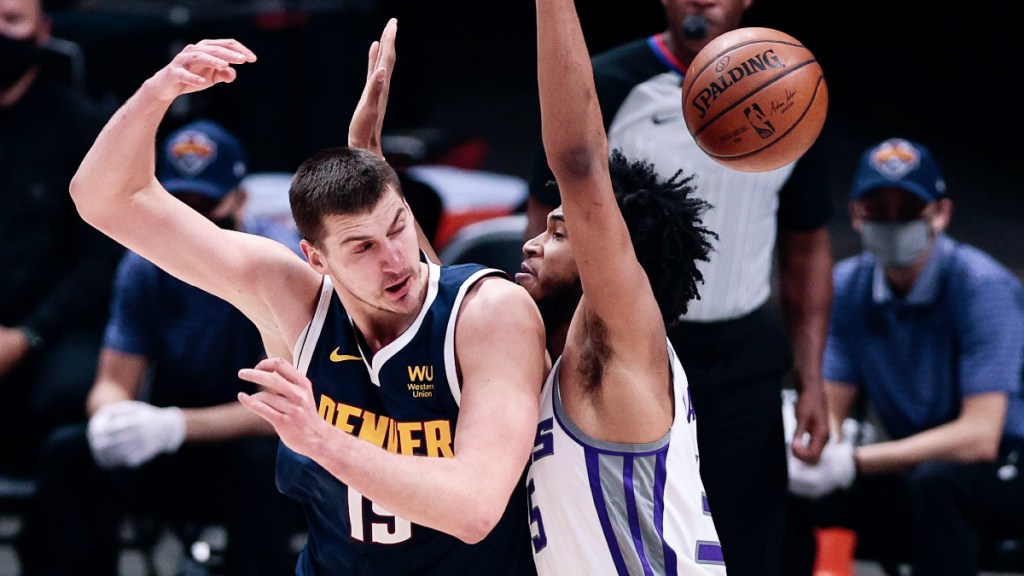
So what is it? Is Palantir high-growth tech or an overpriced consulting firm? I have said this before, but Palantir provides solutions to problems that companies do not even know exist yet. Palantir is in many ways the Nikola Jokić of stocks. There is no player in the NBA like Jokić, who was the lowest-draft player to win NBA MVP. On the surface, he looks like an unathletic big man that should ride the bench, but in reality, he is a star that passes like a point guard and can make 3-pointers. No NBA star plays like Jokić at his size (nearly 300 pounds). It is hard to evaluate Palantir because there has never been a company like them before, and their services are unique to the market.

  • Risky now because they do not have a broad customer base.
  • The Total Addressable Market is massive.
  • Saas revenue model from Monthly Recurring Revenue (MRR) is highly profitable.
  • High switching cost is a Moat.

Lemonade (NYSE: LMND) Chris Rock said in an interview with the Breakfast Club that unfunny comedy is a product of comedians who fear being canceled. Being a great comedian requires you to be a risk-taker. The same thing goes with being a great investor. If you do not take any risks, you will have guaranteed mediocre returns. Consider the average fund available to invest in has over 150 stocks, and those companies get turned over every year. Ask yourself, where is the edge in that?

Lemonade is a big-time risk. It is among one of the most hated, ridiculed stocks in the market. There is no timetable for profit however, the opportunity is massive. Right now, Lemonade is like a car halfway built. Evaluating Lemonade’s performance when its products are not rolled out nationwide is a bit shortsighted. Their future flagship product, car insurance, just launched in only their second state, Tennessee, last month!

Lemonade has a TAM, as big as any publicly-traded company. If Lemonade provides a better onboarding experience, offers lower rates, loses less on claims, and payout claims in minutes, it will gain millions of new users. For Lemonade, more users equate to more data points, and their overall network becomes smarter. This creates more efficient underwriting and accurate pricing. The scary thing is that the market for car, home, renters, pet, and life insurance is so big, that they don’t need to overtake State Farm or Geico to experience exponential growth. If they can just take a slice of the overall market share, the stock will be a 1,000% gainer in a decade.

  • Powered by AI and using telematics allows Lemonade to undercut its competitor’s prices.
  • The suite of products: car, home, renters, pet, and life being offered globally equals a large TAM.
  • Potential of a Network Effect if consumers find Lemonade significantly better than its competitors.
  • Social impact makes it different from traditional insurance.